
SONIC FEELDING
In conversation with Lorea Burge on amplifying the imaginary and recording the actual
Lorea Burge and Imke F. Gerhardt | November 2026
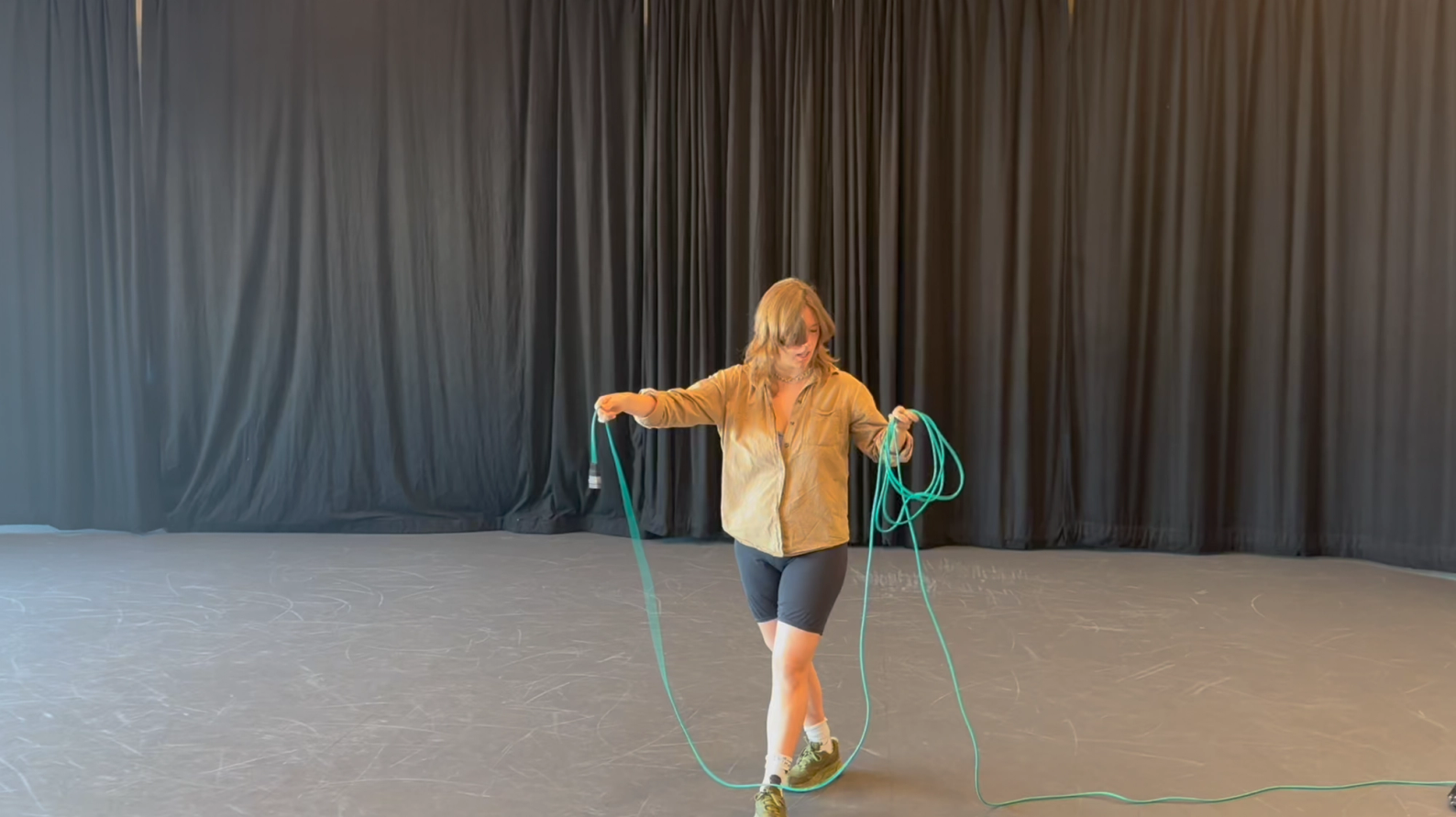
What sounds does the body produce: the moving body, the body in love, the body in pain, the working body? How do we become aware of these sounds, cultivate a practice of listening, and develop an ability to imagine those we are unable to hear?
Visiting choreographer and performer Lorea Burge in their studio, this conversation traces their practice, Sonic Feelding, without attempting to arrive at a concrete definition. Similar to what is central to Sonic Feelding — the processual, sensing, listening, and playing with the sounding body — this exchange remains loose and drifting, opening up more questions than seeking definitive answers.
Sound is immaterial, yet it produces profoundly material sensations in the body. It is invisible, yet capable of creating presence. Perhaps these are questions that resist explanation and are better approached through the sensing body — the body through which sound is accessed, experienced, imagined and produced.
At the core of this conversation are the questions: How does the body sound? How does sound produce bodies? How do we listen to something we might not actually be able to hear, but can nevertheless imagine? And how is this imagination linked to what we have heard before, remaining as a sonic presence within memory?

Imke: Sonic Feelding makes me think of something processual. The word itself suggests something ongoing — something still taking shape.
It makes me think of sound in relation to space: how, despite its immateriality, sound produces spaces and bodies.
Lorea: the feeld is related to process, an expanse of questions that I am intuitively drifting through. I think the title Sonic Feelding emerged from a question that has been central to my practice: what is the potential of my body as a musical instrument?
At the same time, I wanted to explore what it would mean to carry out every stage of the process and production myself — to make the music with my own body and then let that same body move in response to it.
Imke: Where does this idea of the body as a musical instrument come from? As dancers, we are often trained to respond to music, which can make us less aware of the sounds we produce ourselves. Personally, I’m very interested in moving without additional music, and in watching performances that use the absence of music as a conceptual tool. It seems to me that generally, there is a certain clarity that emerges when movement and sound are directly linked. It is more precise and concrete, although it might feel more abstract. I can trace a direct connection between movement and sound, what is seen and what is heard. It is about the actuality of an action rather than the representation of something.
Accessing
Lorea: The desire to explore the body as a musical instrument came from a dream — or wish — to be a musician. I’m surrounded by musicians, and I love going to experience live music as an art form. I find it beautiful how accessible it is, how one can encounter it as an audience member in a relatively passive state. It doesn’t demand your full attention.
By contrast, contemporary dance can sometimes feel off-putting to audiences because there seems to be an expectation that they need to understand what is happening. With music, people rarely approach it through the category of understanding. No one leaves a concert saying, „I didn’t understand it.“ Understanding simply doesn’t seem to be the relevant framework.
Instead, you tune into different senses.
That was the starting point of my curiosity: what would shift in terms of perception and expectation if the body itself were treated as a sounding musical instrument?
More generally, I’m always drawn to process as performance — to watching people make or build something in front of me.
These two interests became the starting point. If I wanted to be a musician, but didn’t play an instrument and had no formal musical training, what tools were available to me?
Well, my body in movement, and my body’s contact with space.
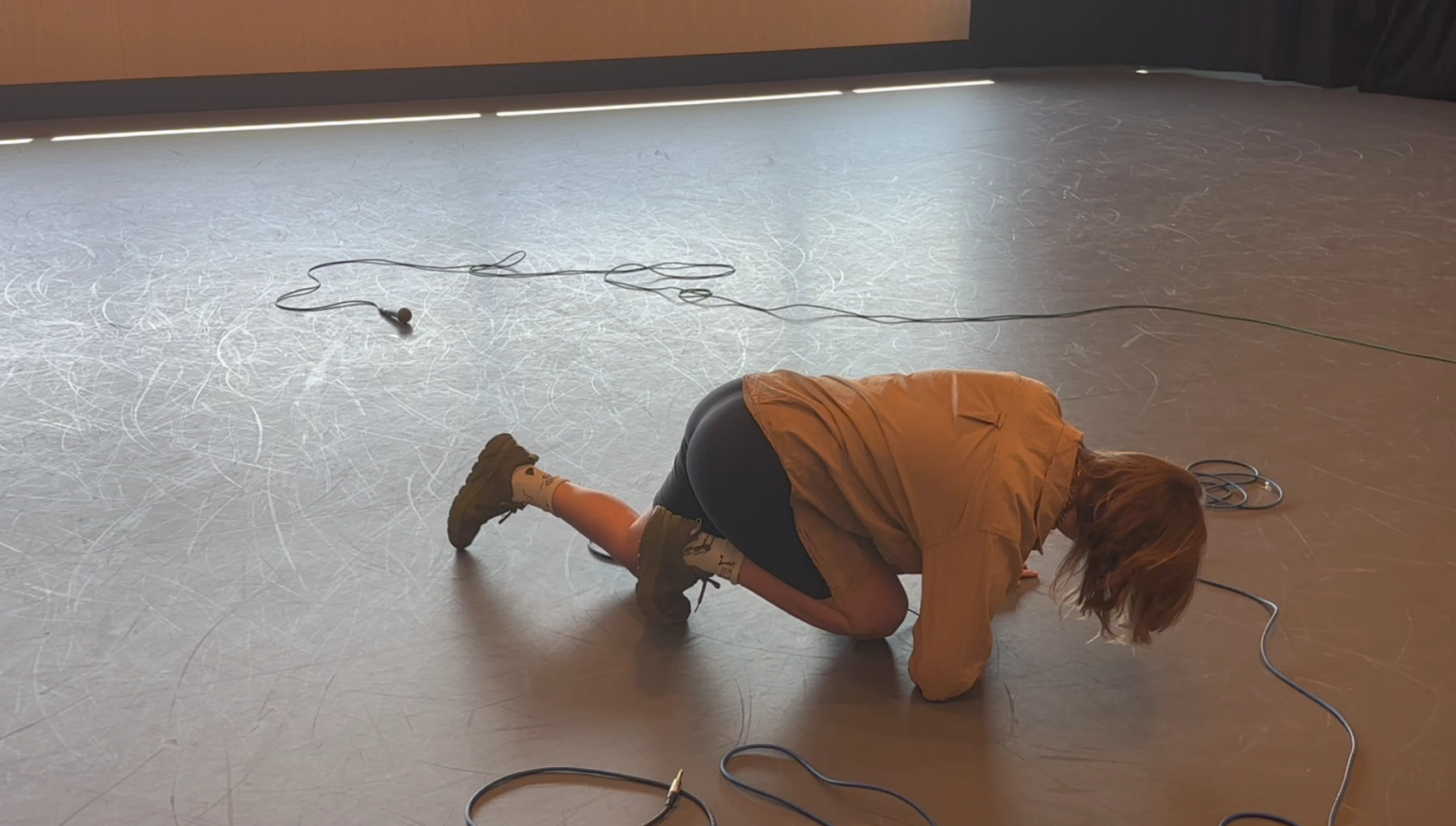
Imke: Yes, I’m also drawn to the accessibility that seems to be linked to sound. Perhaps there are two forms of accessibility that correlate.
There is the immediacy with which sound enters the body. We seem to be affected by it on an almost subconscious, sensual level — prior to interpretation, prior to conceptualisation. And perhaps this immediacy translates into the way music is received and shared.
It tends to feel more horizontally accessible, less dependent on specialised knowledge or particular forms of literacy.
At least in my experience, sound reaches me more directly than what I encounter through vision. The visual often prompts me to identify, categorise, and interpret what is in front of me, whereas sound seems to move through the body first.
Understanding
Lorea: There is a practice by Pauline Oliveros called Deep Listening, which I often return to as a way of attuning my ears. I think listening — and sound more broadly — offers a much more experiential way of understanding things.
Through the process of exploring my body as a musical instrument, I realised that there are many layers to it. One of them is frustration: the realization that perhaps there is not such a great variety of sounds that I can actually produce.
And from that frustration comes imagination.
When I move my arm through the air, I may not hear anything immediately, but I can still try to listen. Maybe there is a sound. Or maybe I begin to imagine one and wonder what it would be like if there was a sound.
I have a practice that I call Amplification Score. Using my voice and a microphone, I amplify sounds that I cannot hear my body produce. In doing so, I try to remain faithful to the thing itself. I don’t want to make just any sound; I try to listen carefully and imagine what that sound might actually be like if there were a microphone sensitive enough to pick it up.
I then attempt to produce that imagined sound with my voice while moving, but also through my body’s contact with space.
Imke: I find this particularly interesting from an epistemological perspective. Our understanding of sound — and the way we relate what we hear to what we see — is deeply shaped by experience and socialisation. We learn to associate certain sounds with certain actions, materials, and images.
What fascinates me about your approach is that you seem to reverse that process. There is an action, a movement, or an object that does not produce anything audible to us, yet you imagine a sound for it and bring that sound into existence. In doing so, you draw on a personal archive of sonic experiences, imagining what might plausibly be heard.
Usually, sounds evoke images. Here, an image or an action gives rise to an imagined sound.
However, I’m wondering what happens when the relationship between sound and image is disrupted altogether.
I was thinking of Dogtooth by Yorgos Lanthimos, in which two children are raised in isolation and taught incorrect names for everyday things — the sea, for instance, is called a couch. The film reveals how profoundly our perception of the world depends on learned associations.
What happens when the correspondence between what we see and what we hear no longer holds? Perhaps these disjunctions allow new meanings to emerge. Or perhaps they remind us that our ways of perceiving and inhabiting the world are contingent rather than given.
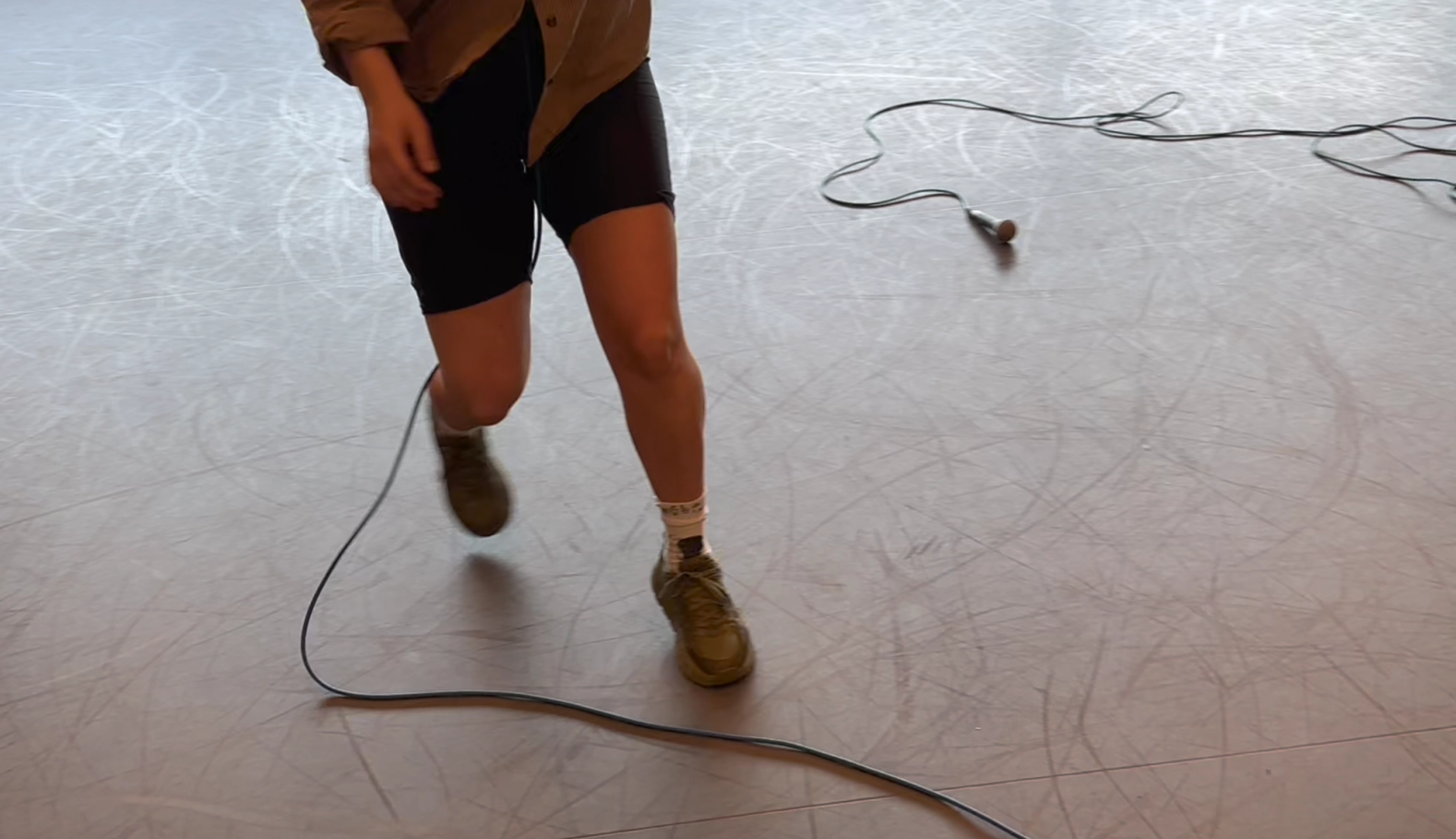
Feedbacking
Imke: I’m curious about how Sonic Feelding shapes your relationship to yourself.
Producing sound — or perhaps using one’s voice in particular — can make you acutely aware of your own presence, especially when you are listening attentively to what you are producing.
What interests me in your practice is that you also record and layer these sounds. In a way, this allows your past presence to linger in space. You then encounter that presence again and respond to it, both sonically and through movement.
It makes me wonder, how this process affects your sense of self and your self-awareness. What happens when your body is in dialogue not only with the present moment, but also with traces of its own past actions?
Lorea: This is something I’m still figuring out.
For me, there is a process that happens in the mind. When I’m jamming, I try to produce something that feeds back into my body and makes me want to move. It’s similar to the experience of being in a club, when the music takes over and your body simply starts dancing.
That’s the kind of feedback loop I’m interested in.
I move to make sound, and I make sound in order to move.
I often work with three prompts. Wherever and whenever I move, I keep these questions in mind:
- Moving while trying not to make sound
- Moving to make sound
- Moving to make sound, but not making sound.
With the third one, I mean that I’m moving with the intention of producing sound, but I stop myself just before the sound emerges. These three prompts drive the movement. I usually practice them for about half an hour as a warm-up, without any equipment.
Before I begin, I also use Deep Listening as a way of tuning my ears. In complete silence, I try to hear as far as I can. It’s a way of preparing myself to listen to my body moving through space.
Imke: Those prompts are fascinating to me.
What immediately came to my mind is classical dance training, where one is often taught to move silently, to create an impression of effortlessness and weightlessness. When you jump, you should not hear the landing. The sound is removed, and with it the labour. The expenditure of energy required to execute a movement. The weight that pulls the body back towards the ground. The force needed to lift it again.
This is one of the reasons why I was so drawn to your recordings of sounds of labour. Labour becomes audible. It is captured and carried by the sound itself. When these sounds are suppressed, it is not only the labour that disappears. Something of the actuality of the action seems to disappear as well. The movement remains visible, but its material conditions become less perceptible.
What I find interesting about placing these three prompts alongside one another is that they open up a space to explore the gap between an action and its representation.
I’m particularly fascinated by the third prompt from the perspective of energy: moving towards a sound, accumulating the energy required to produce it, but holding it back at the threshold of becoming audible.
Lorea: Yes, I think the third prompt produces something quite particular in the body, both physically and perceptually. Through it a movement language is arriving that I dont think I would have accessed otherwise.
Situating
Lorea: Deep Listening is, in some ways, a meditative practice, but it also affects my everyday life. I’ve become extremely sensitive to sound. Over the last few years, I’ve also started to experience sensory overload more frequently, particularly in relation to sound. Sometimes I wonder whether this is, at least in my case, less connected to my neurodivergence and more to the ongoing process of attuning my ears through practice. In the overstimulated and loud environments we live in, I also take pleasure in making space for the smallest of sounds to come forward.
Imke: Becoming more sensitive would make sense to me. How practical that is in a city like London is another question. We live in environments saturated with sound, and filtering out much of what surrounds us feels like a necessary survival strategy. Given how closely hearing is linked to orientation, balance, and our sense of being situated in space, fully attending to all the sound of a city would be overwhelming, even disorienting.
But speaking of finding oneself in relation to space through listening, I find it fascinating that deep listening is how you begin your practice.
In contemporary dance, it is common to take time to arrive in a space before beginning to work. What interests me about your approach is that this arrival happens through listening. It feels like a way of opening yourself to the surrounding environment, of taking in the space before acting within it. Paradoxically, by extending your attention outward, you seem to become more present to yourself. The more you listen to the space around you, the more clearly you appear to locate yourself within it.
Generating
Lorea: For now, I’ve mostly been playing and trying not to focus too much on conceptual frameworks.
In the labour of the research what I’m beginning to notice is a distinction between more analogue methods and technological approaches. There are these two strands within the research. One involves exploring things without equipment, in a more raw and immediate way, often guided by imagination.
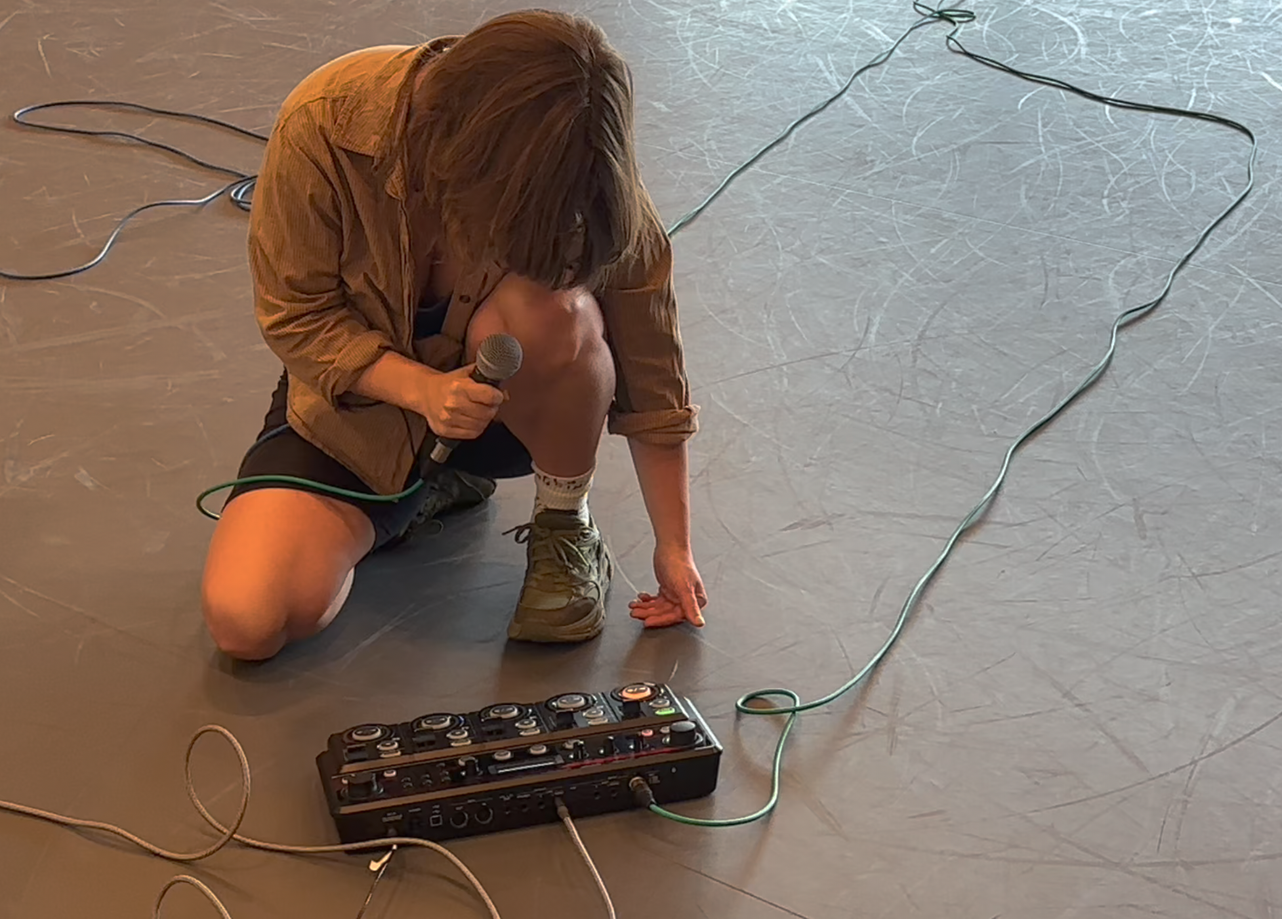
Then there is the technology: microphones, processing, Ableton. I’m still very much a beginner when it comes to the software.
And what is also a central part of the process — feeling quite lost inside the software.
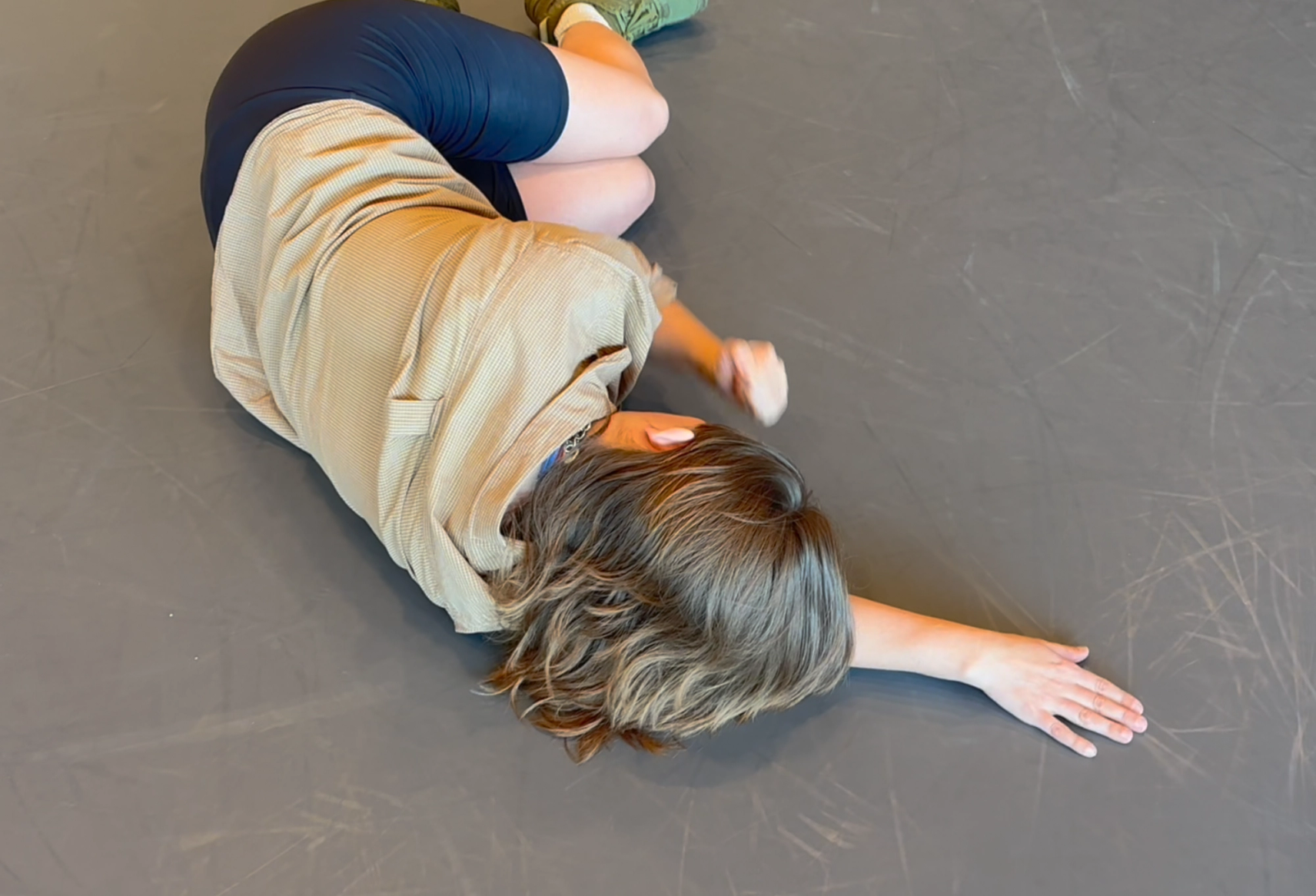
Imke: What strikes me about this practice is how self-generative it seems. You’re constantly working with the feedback produced by your own actions, responding to yourself in an ongoing loop.
I find this particularly interesting because, in my own practice, I tend to prefer improvising with other people. Being in relation to another body creates an endless source of stimuli and possibilities for movement.
What fascinates me about your approach is that, through sound, you seem to multiply and extend yourself. The sounds you produce become material that you can encounter again and respond to. In that sense, you create your own conditions for dialogue.
This also makes me wonder about the difference between working analogue and working with technological tools. Technology allows you to record, store, and redistribute traces of previous actions. It enables a form of encounter with your own past presence that would otherwise be impossible.
Lorea: I’m immediately not alone anymore.
In particular with the technological methods, it feels as though I’m creating bodies.
When I’m working with all the equipment, I don’t feel alone. I’m surrounded by physical objects that are also producing material in the space. They become part of the process. Something I am beginning to touch on is the idea of ‘the band’, by inviting other artists to join me in these practices.
I’ve had the privilege of engaging in very slow research and production, which is something increasingly rare for artists.
During my two years at the Rose Choreographic School, there is no expectation of a final product. At the beginning, I realised that this was an opportunity to slow down and resist the pressure to produce something. Instead, I wanted to explore what it means to simply play without thinking about an outcome.
At times, that has been difficult because we are so accustomed to measuring progress through results. Often, I leave the studio feeling as though nothing has happened. Part of the process has been learning to accept that feeling and to trust that things are moving, even if very slowly.
Everything else that occupies me feeds into the research as well.
I’ve been deeply engaged in activism, particularly in the last three years in regard to Palestine and the genocide that’s happening there. With a focus on Sadler’s Wells’ partnership with Barclays — making art within an institution whose leadership values do not align with my own creates a profound tension. That tension is present with me whenever I enter the building.
It has also led me to a larger question: how can activism — which often requires directness and explicit positions — coexist with the kind of art I am drawn to making, an art that tends to dwell in ambiguity, complexity and nuance?
I’ve been trying to find ways for these two things to meet.
I’ve explored this in fragments, including through writing protest songs, which eventually led to an Action I presented at Fest en Fest.
The piece emerged from my experience of slow processes and from a hopeful belief that the accumulation of small gestures of resistance can produce change.
It is an invitation to trust that even the smallest action will accumulate with others, creating change.
I’ve been exploring this through sound and language, while also searching for a visual metaphor.
In the performance at Fest en Fest, I worked with the vibrations produced by sound itself. Using a short loop pedal, I made very small movements — sometimes almost imperceptible to the eye — which were picked up by microphones. Through repetition and accumulation, these tiny gestures, these small vibrations, gradually dissolved words that I had written on top of a speaker.