
A Distance That Returns
On Sound and Relation
Luc Döbereiner | November 2026
Everything is in relation to everything else, but most relations are somehow disguised: difficult to observe, impossible to fully grasp. In order to make meaning of the world, we therefore tend to objectify relations, turning them into things with properties.
Sound is particularly difficult to grasp. Despite—or perhaps because of—its in-between quality there is an urge to demystify it by locating its origin, to capture its body in order to store, transfer, or sell it. The composer and researcher Luc Döbereiner explores the ontological qualities of sound, precisely through its elusive and relational nature. From a phenomenological perspective, he examines the complex properties of sound as they shift through processes of mediation.
How things and relations co-originate; how something as relational as sound can take form; and how this form, once it becomes a thing, can nevertheless retain its relational qualities—preserving the mediations through which it has come to be—are at the heart of this text and of Luc’s composing practice.

Relations are covered over by things. And things have properties: soft or rare, expensive or blue, surprising or made of glass. Properties are what present themselves, lending the thing a sense of autonomy and casting a shadow over the processes by which the thing came to be and over the web of relations that sustains such properties, the relations that made rarity expensive or softness cheap. Capital is the classic case: a social relation that appears as a thing, a magnitude that seems to grow of its own accord, having absorbed and erased its own conditions — exploitation, abstracted.1
Sound is objectified with the same ease. It becomes the sound of something, itself a property of an object, its acoustic signature. It is captured in recordings and rendered storable, transferable, saleable. It is represented in notation and abstracted into an object-event, the note, with properties of its own — pitch, duration, dynamics — as though these were things a sound has rather than ways it relates. The indefinite article, a sound, already delimits it, cuts it out of time, space and timbre, and makes it countable.
Turning relations into things is what makes distance possible. Where there are only things, connection becomes secondary and accountability a matter of choice. Relation shrinks to position, and one can say: we are here, they are there.2 When we are not confronted with the consequences of our actions, however contingent the routes by which they travel, we are separated in an ecological sense — the loop between act and effect has been cut somewhere out of sight. And this distance is manufactured. Separation is a technology for making a relation unaccountable rather than for ending it. Walls, surveillance and military occupation are its heavy machinery, but there are subtler forms of unrelating, of unsharing a space: limited liability and the subcontracting chain, the slaughterhouse and the prison, the domestic servant’s separate staircase, “market forces”, the gated community, the externalized border with its excised migration zones, or, at the small end of the scale, noise-cancelling headphones — separation achieved by producing a cancellation signal. In each case a boundary is installed and reciprocity withdrawn, while the relations themselves keep running across the boundary, concealed and asymmetric. Distance and proximity are made.
Not every boundary is undesirable. A door that can be closed, an opacity that can be claimed, are refusals, and refusal is sometimes the only sovereignty available.3 What marks the technology of distance is asymmetry: the relation persists, but only one side can see it, act on it, revoke it.
It is tempting to enlist sound against all this. Sound, we are told, is temporal, immersive, surrounding; it leaks, crosses walls, refuses delimitation; it dissolves the distance that vision installs — a medium of immediacy and intimacy.4 But this forgets that sound separates as readily as it joins: masking, cancellation, insulation, recording, silence. And the deeper mistake is not the ranking of the senses; it is the ideal of immediacy itself.5 No sense touches the world without mediation. Sound exists only in passages — through membranes, air, bone, current and code — and what presents itself as pure presence is mediation made to disappear. Immersion is manufactured as surely as distance is. The wish for the unmediated repeats, from the other side, the gesture of the thing: where the thing hides its relations behind properties, immediacy hides them behind presence. Both eliminate the middle, and the middle is where relations can be traced. Neither the unconcealment of hidden relations nor sound “as such” restores accountability. What sound can be is a material for thinking and experiencing how things and relations co-originate, not only how things are in fact related, but how they and their relations arise together, and how proximity might be turned into reciprocity, or at least into an awareness of it.
One path out of the shadow of the thing is a naive question: where is a sound? Is it where it is mechanically produced, where objects move and meet, a stick striking a drumhead, a capacitor discharging into a circuit, the coil of a loudspeaker oscillating in its magnetic field? Is it in the medium: air, electromagnetic field, digital signal? Is it in the room, diffuse and distributed, reflected and refracted, delayed and filtered by every surface it encounters? Or is it in the listener, in the mechanics of the ear, in auditory cognition, in phenomenal experience?
Pressed like this, the question evaporates. Every candidate is real and none is sufficient. Sound is not in any of these places because it is not the kind of entity that is in a place. What comes forward instead is a process: sound emerges through relations. It does not enter a medium fully formed, merely to be disturbed on its way by noise or bandwidth; the relations that give rise to it are themselves medial; they run through air, membranes, currents and code, and they do not precede it. Sound and its relations co-originate.
The classic question of relation is that of priority: do the relata, the terms to be related, come first, or the relations? What if both come to be together? To capture the interconnected paths of operations that sound opens up in its appearance, I avoid the term network, which captures neither the fluidity of sonic relations nor their coming-to-be, and borrow instead the term “sound circuitry” from the sound artist Raviv Ganchrow: “Anything and everything may participate in sound’s circuitry from forces and signals to materials, artefacts, subjects, places and knowledge – just as long as they circulate along interlinking pathways that give rise to subsequent movements, and their configurations are productive of discernible effects.”6 A circuit, in my use of the term, is the relational taking-form of sound which, at the same time, gives rise to those relations.
This is where composing begins for me. Composing, literally a putting-together, I understand as relation-making, as attending to, building and exposing sound’s circuitry in specific configurations: not the arrangement of finished sounds but work on the processes by which sound takes form. The best name I know for such processes is the one Gilbert Simondon gave them: transduction.7 His image is the crystal. In a supersaturated solution, a seed structures the thin layer of liquid around it; the newly structured layer becomes the principle for structuring the next; form propagates step by step, neighbour to neighbour, and at no point is it imposed from outside upon a passive material. Form is not a mould pressed onto matter; it is an operation that travels. To compose transductively is to prepare metastable conditions — a circuit, a system of couplings, a room — and to work with the propagation of structure through them, so that every state of the sound is at once a result and a germ.
None of this dissolves things. What emerges from relations also exceeds them, at least to a degree. Sound detaches itself, appears autonomous and separable; its properties present themselves as its own: a pitch, a timbre, an interval, a gesture. I have no interest in melting these identities back into an indistinct preindividual field. What interests me runs in the opposite direction: which relations a thing maintains within itself, and through which mediations it has come to be. Musical entities illustrate this. An interval is literally the name of a relation, and the relation is more stable than its terms: transpose a melody and every pitch changes while the melody survives, because what we recognized was never the pitches but the distances between them. Timbre is a relational profile: a configuration of partials, their weights, their transient life; no component of the spectrum is the timbre, only the way they hold together. Timbre is how a sound relates to itself. And a gesture is nothing at any single instant; it exists only as passage, a tension between where it comes from and where it is going, a unity produced by relating states. The thing, examined, is a knot of relations that sustains a shape — relation at a slower timescale.
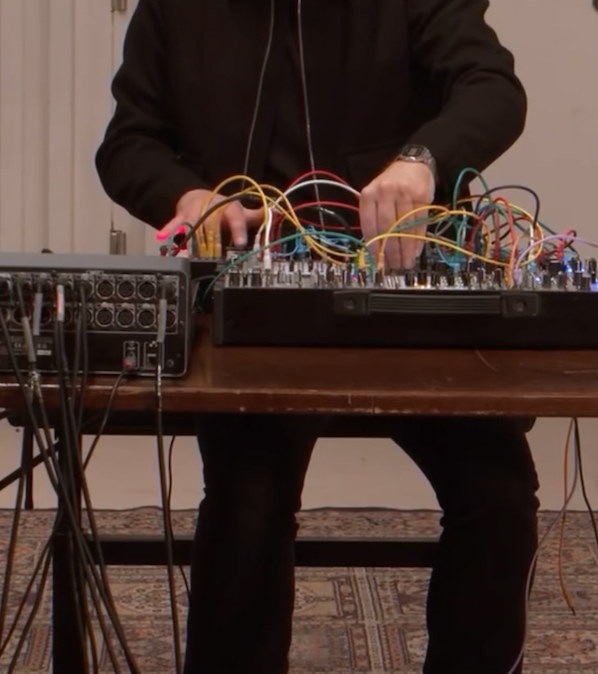
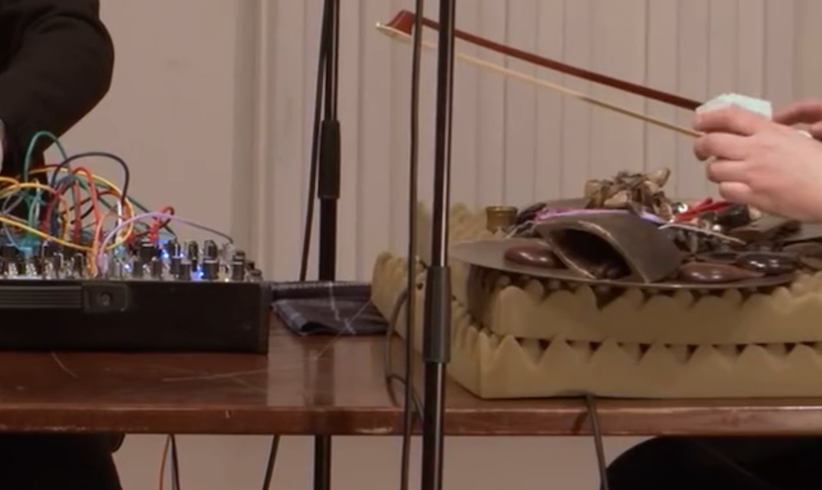
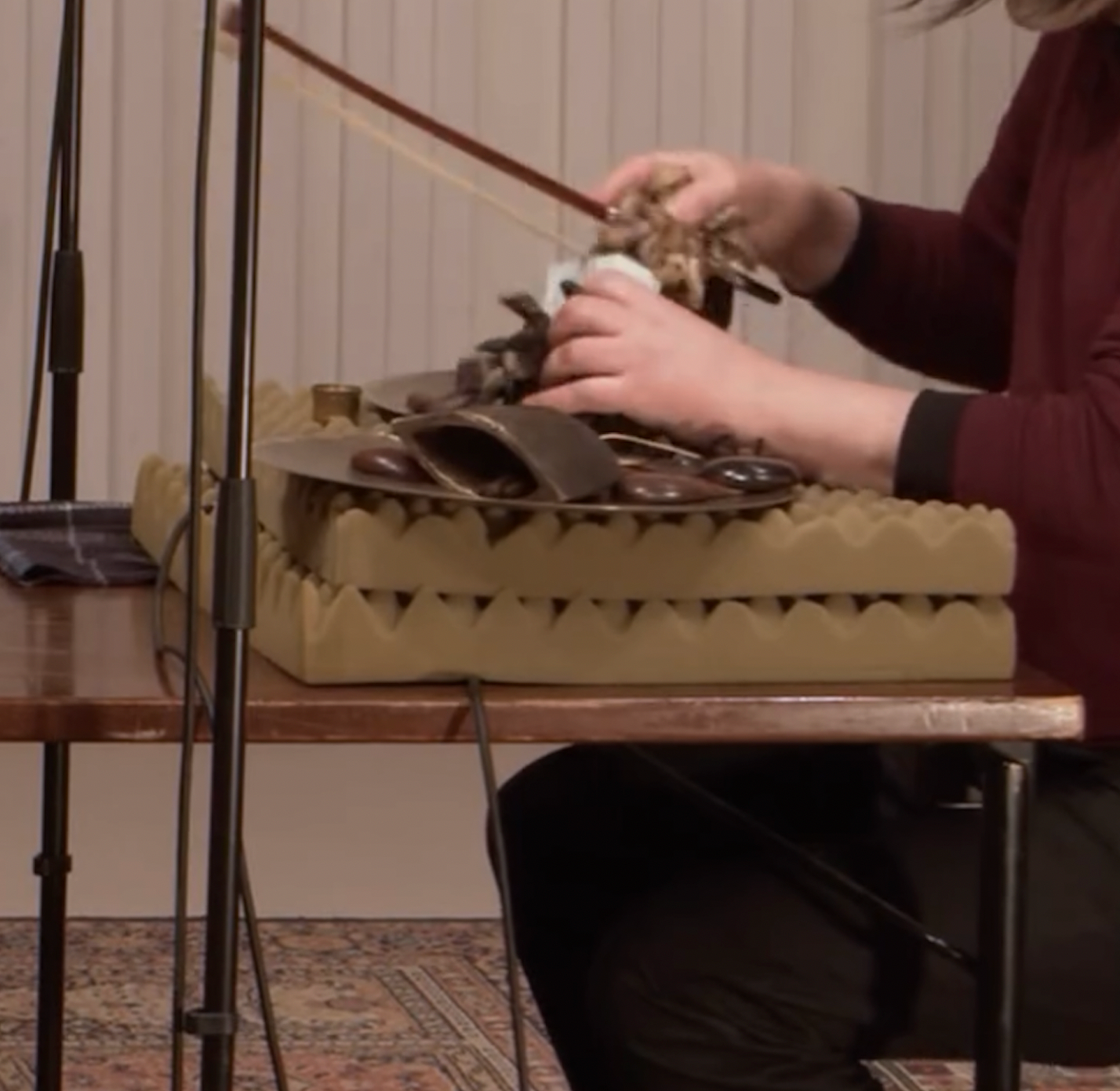
In my work I often build recursive circuits of sound: synthesis and adaptive algorithms in a computer program, loudspeakers sounding a room, microphones returning the room to the computer, sometimes instruments and performers inside the loop. Sound circulates through computational, acoustic, social and perceptual media, producing relations and taking form as their trace. Composing, then, is less the arranging of finished sounds than the design of such a circuit and its dispositions; the form is the behaviour of the whole. Let me walk through one and describe how, at each point, relations produce sound and sound in turn produces relations.
The principal points of transduction are microphone and loudspeaker. A membrane transduces between media: mechanical vibration of air on one side, electromagnetic signal on the other. These are not two manners of appearance of the same thing. The microphone does not register a sound that already exists; it creates a new one by establishing a relation between domains that otherwise do not communicate. It is also a drastic projection: the extended, multidimensional acoustic field of a room collapsed onto a single line, one pressure value after another — a reduction so severe it amounts to a creation. The loudspeaker, at the other end, is no neutral window through which a signal becomes audible. It is an object acting in a space; the sound that occurs is produced by the relation between its physical construction — mass, resonances, directivity — the signal it is fed and the room that answers. In many of my works the two are joined into a circuit: the microphone listens to the loudspeaker playing what the microphone hears. In this reciprocal loop sound arises that belongs to no component — not to the room, not to the transducers, not to the electronics, but to their coupling. Feedback is the relation that cannot conceal itself: every output returns as input, every action is acted upon.
In such sound circuits, sound variously appears as signals of different materialities: analogue oscillations of voltage, electromagnetic fields, sampled digital signals. Such signals oscillate at various speeds and amplitudes; they can be noisy, broad or narrow. Whether synthesized or recorded, signals can be modulated. When one sound continuously varies another — its speed or amplitude, for example — the result belongs to neither. In frequency modulation — both a means of radio transmission and a technique of sound synthesis — the spectrum that appears is generated by the ratio of the two frequencies and the depth of their coupling: spectral sidebands, novel frequencies that neither carrier nor modulator contains, a timbre that lives in the relation itself. Modulation is audible proof that a property can be borne by a relation rather than by a term. It also quietly abolishes the difference between material and operation: what shapes the sound is another sound, signal working on signal, until the distinction between the thing and what forms it collapses into a single fabric of mutual variation. Form is co-produced, not applied.
Modulation is possible only because the circuit is nonlinear. A linear system, however elaborate, obeys superposition: its whole is exactly the sum of its parts, and no frequency leaves it that did not enter. Nonlinearity breaks this law. Where signals meet in a nonlinearity they do not merely add; they are brought into contact, and something comes into existence that was present in neither alone — sums and differences, sidebands, harmonics, and, when the nonlinearity is folded into feedback, unending, never-repeating form out of almost nothing.
A particular kind of modulation is adaptation: a system relating itself to a signal it receives, adjusting so as to approach it. Here form arises out of a disparity and a force that works to close it. Spread across a network of agents, mutual adaptation produces synchronization and its failures — entrainment and drift, chaos and noise, rhythm. Such a network is already an ensemble.
The collective. When musical agents play together — an ensemble of musicians, a network of algorithms, or both — each adapting to and altered by the others, this is not a meeting of finished musical subjects who then exchange information. What arises is a shared form that none of the participants contains in advance and that, in arising, constitutes them: the group and the relations that individuate its members appear in one and the same movement. Each voice is precipitated by the ensemble as much as it contributes to it. The music is this collective mediation — individuation continuing beyond the individual.
Resonance. Where the circuit involves the air — where a loudspeaker projects sound into a room — the room does not receive it indifferently. Sonic relationality does not mean that everything is related to everything; resonance and filtering are operations of selective response. A string, a plate, a room, a filter circuit: each answers only what approaches its own modes, amplifying the frequencies it can already almost produce and passing over the rest. Resonance is a kind of recognition — a body discloses what it is made of by choosing what to answer — and filtering is its negative: to relate is always also to not-relate. The simplest filter is made of delay: a sound meets its own delayed return, the two reinforcing each other where they agree and cancelling where they do not; repeat the encounter and the delayed double becomes a ringing, a pitch precipitating out of self-relation. A room performs this continuously — every space filters what sounds within it, and the sound takes on the space as part of its own identity.
Relations are sparse, selective, built. This is what keeps relational thinking from tipping into a mysticism of total connection, a world so entangled that relation, become universal, explains nothing and answers for nothing — as unaccountable in its diffusion as the thing was in its isolation. A relation that matters can be traced: this mode, this frequency, this coupling and not another.
Spatial hearing. We locate sound by relation. Between the two ears lies a temporal disparity of some tens of microseconds, shaped on its way by the head, the torso, the folds of the outer ear. Neither ear’s signal contains space. Hearing resolves the disparity into a dimension present in neither of them. It does not receive space, it invents it, building a spatial image out of minute differences in time, with the body’s own morphology as the shaping instrument. The perceiving body is not placed into acoustic space; its form is the operator through which that space arises. Our most basic orientation among sounds is already a construction from relation — from a difference too small ever to appear as such, appearing instead as direction.
None of this restores what the technologies of distance have taken. But a practice built on these figures rehearses what reification withholds: the experience of co-origination, of consequence returning. A feedback system is a small economy without externalities. Nothing in it acts without being acted upon; there is no elsewhere to which the costs can be sent, no position from which to say: we are here, they are there. Distance can still be built inside such a system — but only as delay, and a delay is a distance that returns.

- Karl Marx, Capital: A Critique of Political Economy, vol. 1 [1867], trans. Ben Fowkes (London: Penguin, 1976), ch. 1, part 4, “The Fetishism of the Commodity and Its Secret.”
- “We are here, they are there” was the slogan of Ehud Barak’s victorious campaign in the 1999 Israeli elections, fought on a programme of separation.
- Édouard Glissant, “For Opacity,” in Poetics of Relation, trans. Betsy Wing (Ann Arbor: University of Michigan Press, 1997), 189–194.
- This catalogue of sound’s supposed essences is what Jonathan Sterne calls the “audiovisual litany.” Jonathan Sterne, The Audible Past: Cultural Origins of Sound Reproduction (Durham, NC: Duke University Press, 2003), 15.
- See Anna Kornbluh, Immediacy: Or, The Style of Too Late Capitalism (London: Verso, 2024).
- Raviv Ganchrow, “Sound’s Spatial-Material Circuitry,” in The Routledge Companion to the Sound of Space, ed. Emma-Kate Matthews, Jane Burry and Mark Burry (London: Routledge, 2025), 298.
- Gilbert Simondon, Individuation in Light of Notions of Form and Information [1958], trans. Taylor Adkins (Minneapolis: University of Minnesota Press, 2020).