
Feeling evoking sounds
how Lira Lavix' music takes listeners to her own universe
Lira Lavix | November 2026

What makes sound—and music in particular—so singular is its capacity to evoke an immediate emotional response. But what role do emotions play in the act of making music itself? How does a feeling become sound? How is it translated into tone, into texture, into something audible—something that takes on material form? How does a sensation move from one body into another?
Musician Lira Lavix reflects on the making of her new EP, Nothing Will Ever Be The Same, tracing a creative process that begins not with sound, but with feeling. Yet that feeling does not first emerge as melody. Instead, it finds its initial expression in words—a striking reversal of the familiar assumption that language belongs to logos while emotion belongs to the body. For Lavix, it is through language that melody gradually takes shape. And melody, in turn, requires the body to be fully realised and communicated.
Music begins in the body's capacity to experience emotion. It is through the body's presence and expressivity that this emotion is ultimately carried across, becoming something another body can hear, feel, and inhabit.

Sound conveys so much we don’t realise. Tones, textures, pitches go through us and affect us in different ways, based on our personal experiences and how we navigate the world. I make sounds that work rhythmically together, you can call it music. My music has undertones and sounds of sadness, fear, anger, excitement, and every element that goes into the production of it helps create a sonic landscape. What do you want listeners to feel when they listen to you?
Music can be enough by itself. You listen to one song and it’s a complete work. Or it can be just one part of a performance, meaning you need other forms of art to paint the whole picture. That’s where I reside. Music, voice and performance are tools I use to express feelings, emotions, opinions, and anything else I want to communicate. Sound is a beautiful thing because when turned into music, it becomes art, and art is anything the viewer, or listener, wants it to be. Ambiguity is part of art. Music couldn’t be different. When you hear a metallic sound in a song, it can take you to an industrial or glamorous landscape, depending on your lived experience. How do I conduct the narrative? How do you conduct it?
My music has three pillars: instrumental, voice and performance. In my latest body of work, my EP ‘Nothing Will Ever Be The Same’, I navigate a cycle of self-discovery and self-awareness in relation to the world. My approach was composing music that sounded confused, scared, delusional, dangerous and insane, as that is how I feel when I reflect about the sick society we’re part of. For that I sought elements that aren’t conventional, such as foley (reproduction of everyday sound effects that are added to films, videos, and other media in post-production), digital sounds and my own voice as an instrument (screams, whispers). Every element is carefully added to the track to evoke an emotion, and most listeners don’t even notice these elements, but they feel it. Performance is just as important as the instrumental and vocals parts to me. A stage can be used however the artist sees fit, and although I’m in the music industry, theatricality is a pivotal aspect of my music. To me, it doesn’t make sense to create a song that you want people to feel desperate and perform it with a different energy. If the main energy of a track is desperation, you must perform it desperately. And that’s how I start my creative process, with emotion.
When I write lyrics, they come to me through a feeling. That feeling takes form as words, and as I write down the first words, a melody starts revealing itself. The words are there to evoke an emotion, while the melody, not necessarily. That emotion will be present in the melody once production starts, when I start looking for sounds that convey the specific emotion I felt while writing. For example, in one of my songs from my latest EP, ‘Control’, the main feeling is desperation, with hints of anger, exhaustion, solitude and sadness. They’re helpless and start realising they have very little control over the narrative of their own life. To convey these feelings, when I speak/sing the lyrics, the tone is serious but weak, as someone who has already given up. In certain phrases and words, I want to emphasise a message or a feeling, so I say it differently, emphasizing certain letters or syllables, adding more layers, or changing the sounds slightly to make them more commanding and create fear. For example, you can hear in the snippet below how I create tension with silence, high pitched sounds and by adding low pitched versions of my own voice layered together to create a fear in the word ‘silence’. The instrumental was created to sound scary, with elements of horror and tension, from very high pitched sounds inspired by ‘70s horror movies to very low, heavy ones.
While in ‘Start Game’, another song from the same EP, we are in a different phase of self-awareness, where desperation turned into delusion. The main character is completely insane. Here I make fun of human misery, joining the absurdity of an average life in the West. I support it, I defend it, I am it. Here the music is more repetitive, robotic, machine-like, fast, nervous, pure insanity. In the snippet below you can hear the chorus, where I added a siren-like sound to help create a chaotic atmosphere, as well as myself screaming the words ‘play the game, bathe in blood’ in the background to make it sound almost like an order. The tone of the main vocals are sarcastic and unconcerned while the commanding screams in the background help adding tension and fear.
When talking about performance, I use my body as a canvas. I paint the picture I want people to see through movement. The body emanates immense energy, sometimes even more than music itself. My movements on stage have elements of dance, but they’re primarily instinctive movements. I move how I feel when I sing about poverty, famine, misery. I might put my hands on my neck as if I’m choking, open my arms making myself vulnerable or fall to the floor in complete surrender. That might shock or delight, again, depending on people’s lived experience. Regardless, they will evoke an emotion, it doesn't matter if good or bad, as long as something is felt. I just want them to feel something, and hopefully, this something is strength to fight a broken system.
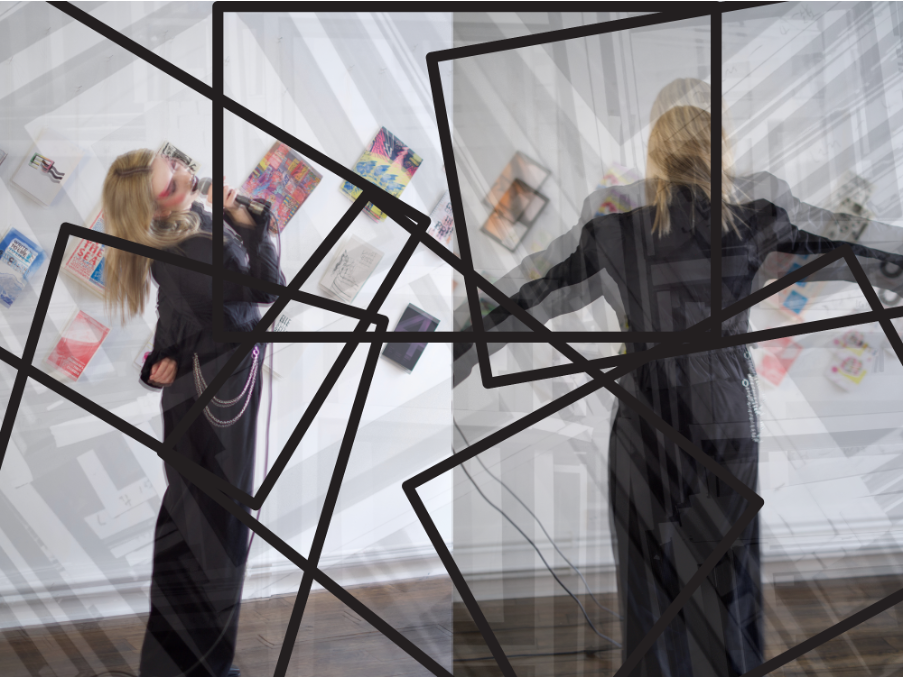
Engaging with the audience is also fundamental, as in that moment, there’s no audience or artist, we’re all the same and we’re all one. We feel the same, we move the same, the energy is created by everyone in the room and together we go through a spiritual connection. I think of it as an immersive music experience where everyone is part of it, almost like a cult. That’s the power of music. The power that is inside of us and we let out, sharing feelings and emotions that sometimes are rooted deep inside or we didn’t even know they were there.. Sounds bring memories back, a person, a smell, a moment in time. They also create new narratives, perspectives, ideas. Sound is whatever you want it to be, and to me, it’s connection, self-expression and freedom.