
Held Long Enough
Vanessa Cimorelli | May 2026
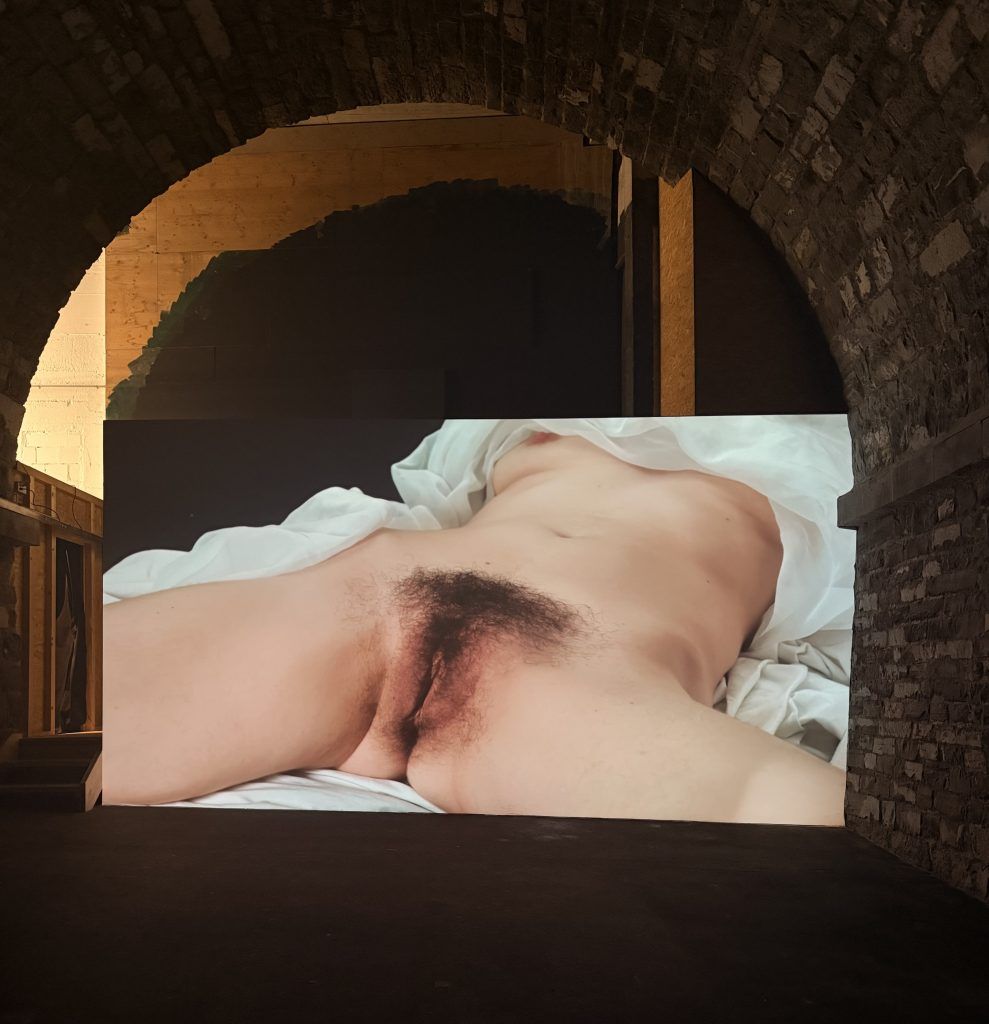
As part of Chapter 2 – Vision and Flesh, which examines the continuity of patriarchal regimes of vision, Moving Discourse presents Held Long Enough, a text by curator Vanessa Cimorelli. The text unfolds in response to The Origin of the World, a short film by Argentine filmmaker Jazmín López, itself a reworking of The Origin of the World by Gustave Courbet.
Courbet’s painting has been as much an expression of a patriarchal framing of the female body – denying subjectivity and reciprocal visual relation between model and viewer – as it has become, in our cultural imagination, inseparable from feminist critiques of the alignment between seeing and power.
In a beautifully sensitive and poetic way, Cimorelli traces her looking at López’s film, rhythmically following the trajectory of her own gaze, which carries both the history of the patriarchal gaze and the critiques that surround it.
López’s film stages a tableau vivant with a female nude: at first, a quiet image, which gradually accumulates what surrounds it – discussions of censorship, framing, and the uneasy histories of the gaze. Cimorelli writes: What emerges is not a reproduction but an exposure of the conditions of visibility themselves. As cinema and painting press against one another, looking becomes heavier, departure feels abrupt, and the image slowly ceases to be silent, waiting long enough to return the gaze.
Editor’s note: The text was originally published to accompany Jazmín López’s film “The Origin of the World", exhibited at Tunnel Tunnel Gallery, 2025, Lausanne.
At first, I thought the image was calm.
That was my mistake.
It doesn’t move, but it doesn’t rest either. It stays in place the way a question stays in the mouth after it’s been asked too late. The body holds. The frame holds. Something else – less visible – starts to accumulate, quietly, without permission.
I look for the center. I always do.”
The center promises order.”
The center promises that I am doing what I am supposed to do.
But the center does not hold for long. My eye slips. Downward. To the side. Back again.
The movement is small, almost embarrassing. Like fidgeting. Like thinking while pretending not to.
The body is there, undeniably. Weight. Temperature. A color that is not symbolic enough to be safe.
Skin that does not explain itself. The longer I look, the less the image feels composed and the more it feels maintained. As if it required effort – mine, someone else’s, everyone’s – to stay exactly like this.
Around the image, things are happening that the image refuses to show.
Talking. Thinking. Arguing. Adjusting. Waiting.
Words circulate about looking, about desire, about an old painting that never stopped making people uncomfortable, about whether discomfort is a flaw or a method. Theory is in the room, but it doesn’t behave like theory. It behaves like humidity, and I do like humid discomfort. It settles on the image. It changes how the air feels.
I notice the absence of a face and realize too late that I was waiting for one. Waiting to be released from the body by a look that looks back properly. Without it, the body does not resolve. It remains open, incomplete, almost impolite. I want confrontation. I want this unease to answer me. My eye keeps moving because it cannot decide where to stop.
This is when time starts acting strangely.
Not longer.
Denser.
Nothing new enters the frame, yet the image grows heavy. The kind of heavy that comes from repetition, from being held in place by too many reasons. The body keeps still, but my attention doesn’t. It edits. It cuts. It assembles versions. I begin to suspect that I am watching several films at once, none of them fully formed.
Breathing becomes audible.
Or maybe it was always there.
It doesn’t get louder. I just lose the ability to ignore it. After so much duration, after so much thought pressing invisibly against the image, breath feels enormous. It feels like proof. Like resistance. Like the smallest possible refusal.
I realize then that I am staying. Again.
Not because I have to.
Because I have decided to.
That decision changes everything. The image no longer feels neutral. It no longer feels like something I am simply consuming. The act of looking begins to feel... noticeable. Exposed. As if attention itself had weight, and that weight was now resting on the image, bending it slightly out of shape.
The body starts to feel less like something shown and more like something enduring – my gaze, the room, the ideas circling it, the history attached to certain ways of seeing. The image is no longer alone. It is crowded; it is loud.
At some point – there is no clear moment – I stop feeling like the one in control of the look. The image does not react, but it holds me. The longer I remain, the more it feels as if the screen is quietly taking note of my patience, my hesitation, my refusal to leave.
This is not confrontation.
It is worse.
It is persistence.
And that, disturbingly, is what I like.
I blush.
When the body finally moves, when the apparatus appears, when the set gives itself away, I feel less relieved than displaced. As if something had been interrupted. As if I had been caught staying too long with something that was never meant to settle.
What remains is not the image.
It’s the sensation of having been involved.
Of having participated in something that did not announce itself as reciprocal but slowly became so. The more I looked, the more the image seemed to collect me – my time, my attention, my unease – until looking no longer felt like a one-way gesture.
I leave with the uncomfortable feeling that the image did not simply show itself to me.
It waited.