
Writing: A Reading
or Performing Writing with Barby Asante’s “Declaration of Independence”
Freya Shi | May 2026
As part of Chapter 2, Vision and Flesh, which examines how dominant visual regimes shaped by patriarchal and colonial value systems delimit perception, Moving Discourse publishes Writing: A Reading by researcher-practitioner Freya Shi.
Power and vision are inseparable. Western, male-dominated academic traditions have long defined what counts as legitimate knowledge production, marginalising other epistemologies and modes of transmission. Spiritual and embodied forms of knowledge, as well as practices rooted in natural medicine, were historically suppressed through processes of colonisation and persecution. Such exclusions continue to structure not only what can be known, but also how we see – and, crucially, how we approach art. Freya Shi’s text proposes an alternative approach to art writing. Moving between critical and creative registers, it challenges the conventions of academic discourse. Each chapter opens with the drawing of a tarot card, a speculative gesture that activates non-dominant epistemologies. Rather than writing about Barby Asante’s Declaration of Independence, Shi writes with and alongside it, using the work as a site to reflect on interdepence, transtextuality, and the performative dimensions of writing itself.
Take this writing as a reading and think about how a writing requires a reader to function; how a writing builds on histories of reading and references both intellectual and emotional; how a writing can transfigure into a poetry reading, a performative event that lives beyond the pages; how a writing can invoke esoteric practices such as tarot readings,1 exercising alternative epistemologies and fortune-telling.
~ 1 of Wands ~
“We begin the pursuit of freedom with the fire born of the Ace of Wands, only to find an unexpected creative communion as the reward for our bravery.”2
What is called a “Declaration of Independence” originated from the thirteen colonies of Great Britian on the Atlantic coast of North America when they severed their colonial relation to Great Britain and declared themselves independent sovereign states in 1776, now known as the United States of America.
“Declaration of Independence” is also a series of performative endeavours hosted by Barby Asante, in which womxn3 of colour deliver a collective performance made from individual declarations that are developed through various workshops and gatherings.
A declaration could be a constative utterance where a fact is brought forth, but a declaration of independence would certainly be also performative, as its utterance changes matters of existing fact and replaces it with a more updated version of fact. A declaration of independence treads through these two modes of meaning-making simultaneously: the subject making the declaration of independence proclaims its independence to be self-evident, while a declaration is still needed to establish this self- evident fact.
A chicken-and-egg situation – this vicious cycle is perpetuated by colonialism.
A declaration of independence is thus a ritualistic and performative action that effectuates itself through changing the space of its happening. Independence is there all along, dormant under the seal of colonialism, waiting. It is backstage anticipating a call to bring it onstage.
This piece itself, is
also intended to be performative,
as all writings inherently
are.
I call on this writing to be my declaration of independence.
~ 2 of Swords ~
“Attempting to annihilate the pain of our suffering, or to cover a tormenting past to the point that we feel unreal, disembodied, and split off, can never balance an awareness of love… But the Two of Swords is a signal that the logical path to inquiry is blocked.”4
While engaging with Barby’s work, various interrelated and overlapping concepts came up: space, history, archive, embodiment, ritual, worldbuilding… What stayed with me was writing, which was so elementary yet fundamental to weaving these concepts together.
Writing also holds personal significance to me. My initial memory of writing was taking a composition course which happens each Saturday morning outside of primary school; it taught me all the model techniques of describing weathers, objects, portraits, and actions but never taught me writing from my heart. While growing up reading world literature in Chinese translation, I found myself held between a reader, highly sensitive to words and the blanks in between, and a writer, feeling small and embarrassed even in her desire to write. Later I was trained in the North American and European education system to write analytical and argumentative essays which I have found to be a strength of mine. Thus, I have adopted the role of a critic, maintaining a critical distance to creative works and writing out of the necessity of argumentation.
However, something has always been lurking beneath the perfectly formatted bibliography, stirring a sense of unease. What is beyond the thesis statement, the analysis, the conclusion? I avoided talking about “I” in my writings, but it is inevitable
that all my sentences originated from somewhere. Feminist scholars and artists have critiqued the abstraction of theory and philosophy which displaces physicality and positionality, and I have learned that the separations between “art and life, theory and practice, work and the self, research and motivation”5 are illusory. Critical writing and creative writing are not exclusive of one another, as writing can be as/about practice.6 A writer writes the role their writing performs.
Thus, this writing on/as methodologies performs the performative nature of writing – just as Barby’s7 “Declaration of Independence” dances at the crossing of writing and performance. This writer, I, is also crossing back and forth the boundaries between theory and practice, poetry and prose, intellects and emotions, argumentation and speculation.
~ 3 of Cups ~
“Our dancing, our celebration is a living prayer. From these memorial gatherings we keep from falling into oblivion, we dance our way into the future, or we ensure a future through our dancing.”8
“Declaration of Independence” is developed by Barby through a series of collective writing workshops for womxn of colour. The edition commissioned by Art on the Underground, Transport for London (TfL), and delivered in the Stratford Station9 was co-created by a group of TfL staff, among whom some self-identify as artistic and many do not.10 Barby led the way through the workshops, gave out prompts for writing, provided feedback, and then weaved everyone’s individual “declaration” together into one intricate piece of Declaration of Independence, which she describes as “a declaration of [their] interdependence and the interconnectedness of [their] stories across time.”11 Barby understands these workshops as a descendant of Black feminist practices where sharing and writing stories challenge existent modes of historiography and story-telling, and where collation of “stories, testimonies, theory, and poetry”12 could engender new experiential landscapes for womxn of colour.
These writings also belong to the practice of “écriture feminine” that brings women to writing and speaking “from which they have been driven away as violently as from their bodies.”13 Through the writing workshops, the womxn Barby works with have returned to their bodies, their braids and acrylic nails,14 and made their “shattering entry into history”15 by declaring their independence from the patriarchal and neo- colonialist world of “take and / take and / take.”16 In fact, poetry was not the point, and what matters is the collective experience of the workshop. From the participants, the workshops were a space where they felt supported and cared for, and oftentimes the majority of the workshop was sharing life updates, among them some could be quite heavy – writing sometimes only happened near the end.17 Not everyone attended every session, but all felt a sense of belonging in the group that brought them healing and joy. Womanhood is about giving, sharing, and nurturing, and conviviality is such a crucial aspect of Black feminist practices.
Through the process of collaboration, Barby’s work does not speak on or about these womxn – she works along with them, which is also a methodology developed by Gayatri Spivak, Trinh T. Minh-ha, Irit Rogoff, Jane Rendell and many other feminist thinkers18 that challenges hierarchical relationality in Western philosophical tradition. For my writing that is about Barby’s work, I also intend to adopt what Henk Borgdorff calls a “third way” of writing about/as practice: instead of interpretation or
reconstruction, the writing becomes an “emulation or imitation of, or an allusion to, the non-conceptual content embodied in the art”.19 I am writing in parallel to Barby’s work, in the feminist spirit that has touched me in Barby’s work; and I celebrate and reenact such spirit through writing on my intellectual-emotional journey alongside Barby’s work.
~ 4 of Pentacles ~
“In this card we learn to speak the language of the Earth, and though we may journey far and wide looking for this seat to set roots, though we may endure changes imposed upon us by the decay and renewal of time, we will always belong.”20
In a methodologies class with Duncan we talked about sight, site, and cite in relation to Agamben’s “Notes on Gesture” and Pasolini’s film Il vangelo secondo Matteo (in which Agamben played one of the twelve Apostles).21 We speculated on why Pasolini intentionally hired non-professional actors: professional actors carry with them a repertoire of gestures and an archive of characters which, with the sight of them, compels a series of involuntary citations that affects the meaning of the sites they appear in.
While Agamben describe gestures as gags, communicating communicability and exposing the mediality of humans’ being-in-language,22 writing-in-language can never keep up with historical memories embedded in the gestures of writing. The most honest writing-in-language is a citational writing, performing its own action of rewriting and referencing. It also bares the construction of identity and history through repetitions, both textual and gestural.23 There is no original thought in the strictest sense, and we
are always already entangled in texts of all sorts.24
There is a long history of logocentrism behind writing as the most acknowledged form of citation and the most prioritized site of meaning-making. What counts as legitimate sources of citation and may therefore contribute to the production of knowledge? What gets left out? To open up the category of citation, Barby’s project included less permanent forms of citation, including memories, poems, photos, songs, diagrams, etc.25 Barby and the womxn activated their own bodies as sites of knowledge, and the sight of their performance and the posters “reclaim, short-circuit, and resignify”26 the space of the underground station.
In the context of academia that this writing is currently situated in, citation
matters as an “ideological performance”27 of what we do as academic work and who we are as researchers. However, no footnotes or bibliographies can exhaust the exact history of our research and the components of our writings. What is considered “academic integrity” may involve, paradoxically, admitting that the footnote will always overflow the main body of text; the bibliography can never be complete; and the claim to individual excellence in research28 is impossible.
Unable to cite all my sources, I wish to take this moment to express my gratitude to all the conversations, dreams, and gestures that have informed this writing…
~ 5 of Wands ~
“The risk is that our dream of a new or truer identity may be shamed, shaded, or still unrealized. The benefit is that the Five of Wands embraces the paradox of identity, the being of many things at once, the continuous redefinition of identity in social space, which affords the spaciousness to more fully be.”29
In terms of the “author,” Roland Barthes famously declared the author to be dead and the text to be freely interpreted in 1967.30 Michel Foucault, however, advised to not make such a hasty decision and suggested, two years later, to be cautious of the operation of the author-function that classifies discourses and disciplines.31
Demystify the author and multiply the author! There are no grand narratives.
More on the author, but in terms of the “I” writing a text, Italo Calvino suggests that it splits into - “an “I” who is writing and an “I” who is written, into an empirical “I” who looks over the shoulder of the “I” who is writing and into a mythical “I” who serves as a model for the “I” who is written.”32 In other words, the author “I” splits into
1) an Ia who is writing,
2) an Ib who is written,
3) an empirical Ic who looks over the shoulder of Ia, and
4) a mythical Id who serves as a model for Ib
5) and “the “I” of the author is dissolved in the writing.”33
There are no grand narratives. No singular ego could dictate the fate of writing.
In terms of the relationality between texts, Gerard Genette proposes five kinds of transtextuality: intertextuality, paratextuality, metatextuality, hypertextuality, architectuality which signifies various actions texts can do to other texts including quoting, wrapping, commenting, representing, and transforming.
No singular ego could dictate the fate of writing. The action, the function, the result of
writing should be as sprawling as possible.
In terms of what texts can do to people (or vice versa), Della Pollock kindly suggests a normative framework for performative writing: evocative, metonymic, subjective, nervous, and citational34 – with a disclaimer that these are not definitional.
The action, the function, the result of writing should be as
sprawling as possible -
a plethora of meaning is more just than a hierarchy of meaning.
And in terms of Declaration(s), it is also important to remember the names of Hannah and Femi, Barby, Buki, Foluke, Alexis, Shirin, Carolyn, Ijeome, Joyce, Kristel, Kathleen, Nancy, Tenesha, Safia, Michelle, Elizabeth,35 who are authors writing with/into/around each other’s texts, trans-per-forming their totality of writing.
A plethora of meaning is more just than a hierarchy of meaning. Writing is always co-
writing, and independence/s is/are achieved through interdependence.
For them, for you, and for us.
~ 6 of Cups ~
“It is a wormhole unveiling every entrance into the streams of time, summoning every profusion of possibility for relational selfhood to manifest in multiplicity.” 36
On May 8th, I led a session of Unit 3 for the MRes Art: Exhibition Studies Year 1 cohort titled “Self-writing, Site-writing.” The session was composed of a seminar on quotations from Jane Rendell’s 2010 book Site-writing and Roberta Mock’s 2009 book Walking, Writing and Performance and a walking-mapping exercise where I asked the group to walk to the King’s Cross St Pancras underground station and record themselves describing their memories summoned during the walk.
The body is a space that provides orientation when we navigate other spaces, both architectural and psychological. The body is a personal archive of ours that holds feelings, thoughts, imageries, memories, etc., among which many we are only vaguely conscious of. In the process of writing, our bodily archive opens up to retrieve and conjure new meanings in our mental-physical inner landscape, like Freud’s mystic writing pad. As the map shows, our bodies often write in non-linguistic and non-linear ways, and no textual archive can pledge full fidelity (just as no citing can fully reference its citations). And when the archive betrays us, when it is “a death sentence, a tomb, a display of [our] violated bod[ies],”37 we have to write our own bodies and perform our own histories instead.
The faux separation between the mind and the body produces the tension between writing and performance, but they should have been siblings (as well as reading as the third child). Barby and her group performed writings, and my writing writes in its own performativity – both are “intimate coperformance[s] of language and experience” where “writer[s] and the world’s bodies intertwine.”38 Think about the concept of “fabulation” which has shown to be helpful for theory of feminist scholars such as Donna Haraway, Saidiya Hartman and more.39 A piece of writing and an act of invention, “fabulation” is on the same page with “declaration” where it performs its own legitimacy, but on the flip side of the coin with the latter when its legitimacy is denied beforehand.
So let us hold hands.
Let us trust in our bodies and write from our bodies as Hélène invited us to do.
Let us perform bodywriting and reclaim the power of our own hands that write.
Let us blow out the shackles on writing and write from our bodymindspirit.
And let us hold hands.
~ 7 of Swords ~
“We deploy a strategic double consciousness and enact narrative insurgency.”40
Louise, the curator for Art on the Underground who commissioned many artworks in TfL including Barby’s, told us about the code-switching she had to do while pushing for projects to come through in a corporate setting.41 With a sleight of hand concepts that are deemed illegitimate become admissible, where an artwork remains disguised until it reaches the public, its critical potential finally shown. For the hegemony it is a “elocutionary experience of a fugitive communication”42 which only the undercommons may comprehend, like an encrypted vernacular.
Writing about curating and confabulating, Sonia D’Alto linkens art to magic for their insubordination: radical political messages could be insinuated through what Susan Césaire calls “the great camouflage of art” similar to the unexpected but transformative effects from a magic spell.43 Art is a cushioned wrapping for activism – what can you do with poetry in a country that proclaims it upholds free speech? And spirituality has often been rendered “bogus” by capitalist-scientocratic governments in both West and East and become something much more recreational and thus innocuous than religion per se. With explosive inside, marginalization can never neutralize the subversive potential of art and spirituality.
I have tried to sneak in some bits of artistic and spiritual explosive in this piece of writing as well. In line with Audre Lorde’s famous saying,44 academic writing can never dismantle the academic system45 that it originated to serve. But sometimes it is a strategic choice to play along the language game to insert seeds for radical meanings, like Louise and Barby did. Therefore, on the one hand I am learning to unlearn “rationality”; on the other hand, I am adopting the form of academic writing to subvert what it can do.
Similarly, Bryant Keith Alexander turns his role of a professor of Performance Studies and (the first Black) dean in the College of Communication and Fine Arts, Loyola Marymount University, into a performance. Bryant describes his autoethonographic work as “a performative fugitivity leading toward a performative futurity for self and others.”46 Thus, language takes flight,47 declaring new independence in the sky; it has risen, as our dear Maya Angelou sang.48
~ 8 of Pentacles ~
“The pentacles they make are more than decoration; they are worlds within themselves documenting a personal history, displaying an artistry, recognizing a cultural influence. The pentacles are thus a commentary on legacy and impact.”49
Following on the discussion on citation in ~ 4 of Pentacles ~ I wish to talk more about autotheory, which takes the self as the reference for critical thinking. Lauren Fournier published a book in 2021 titled Autotheory As Feminist Practice in Art, Writing, and Criticism to explore the histories of autotheoretical practices in relation to philosophy and contemporary art. Against the separation of art and life, theory and practice as in ~ 2 of Swords ~, autotheory crystallizes through post-1960s artistic practices obligated to histories of feminist writing and activism50 (including “écriture feminine” discussed in ~ 3 of Cups ~).
I started exploring autotheoretical writing in a previous essay of my MRes program when I wrote on Saidiya Hartman’s “Venus in Two Acts.”51 I was deeply touched by Harman’s words and Barby’s work had a similar effect on me. I witness that writing can do, act, and perform, liberating words and us from the patriarchal, colonialist, logocentric, capitalist ways of creating knowledge and forming new possible worlds and solidarities. However, it is also a formidable task to write in a performative mode since it constantly “displaces writing as meaning”52 in the familiar mode of academic writing. I had to prod myself into fabricating meaning in uncertain dis/continuous acts, and the spirit of Barby’s “declaration” gave me hope.
I adopt the form of autotheory to free theory from abstraction, and to also free myself from abstraction. I choose to practise performative writing because it welcomes the honest embodiment of various voices and thinkings beyond the structure of traditional academic writing for which I have learned to write in a specific language, style, and format and produce a certain kind of knowledge legible in a certain sociocultural and geopolitical context. More critical was my realization that no methodologies could abstain from ideologies, especially in the setting of academia where histories of knowledge, power, and violence perpetuate.
“We must become undisciplined”53 and we have to undo the disciplines – this is why I situate my writing within an academic framework. Through writing on the intersectionality of my identity and my thoughts, I hope to open theory to life; and in performing my writing activity and my writerly identity, I also hope to open the self to the other, the singular “auto” to the multiple of “us” where critical sympathy could form to challenge existing structures of knowledge that have colonised bodymindspirits for centuries.
~ 9 of Cups ~
“Dreams are a form of data gathering and method for asking for knowledge, just as are the ceremonies. In Native science or IK, dreams are ways that authority and authoritative knowledge are produced.”54
In Barby’s PhD dissertation, she frames her works within the spirit of Sankofa, an Akan Adinka principle adopted as an important symbol in African diasporic cultures. Sankofa is visually represented by a bird with its head turned backwards and feet forwards, carrying/caring an egg in its mouth, commonly meaning “go back and get it.”55 Barby explores Sankofa as a memory practice methodology through a Black feminist and decolonial lens, where the spirit guides her to engage with “silences, omissions, and erasures in the telling of histories connected to coloniality and enslavement”56 and to imagine otherwise for “[a] future undeterred.”57
Western theory and philosophy has been frequented by spirits – consider the word “zeitgeist” meaning “time-spirit” in its German origin; the “angel of history” lost in the storms of progress;58 and the “spectres” of history haunting European modernity… 59 Spirits invoke the question of epistemology and temporality in Western thoughts, while spirits and other spiritualist beliefs have long nourished feminist, Black, Indigenous, and queer thinking-doing to pursue reparation of the past and liberation of the future.
For example, the philosopher-artist duo Denise Ferreira da Silva and Valentina Desideri have developed a practice of “poethical readings” using tarot, palmistry, reiki, etc., a combination of the poetics and the ethics to create a space for alternative sense- making and healing. Their agenda is to displace the “self-knowing, self-determining entity”60 of the Kantian Subject, and to provide orientation to navigate the ethical entanglements of various relationality in our social reality. Bryant (from ~ 7 of Swords ~) and Mary E. Weems wrote a dialogic and performative book around “collaborative spirit-writing” where they describe spirits as “a divine essence and energy of possibility” that fuel actions and activisms.61 Sonia (also from ~ 7 of Swords ~) compares the imagination with divination as it reaches beyond “the limits of what is already understandable”62 and virtualizes what becomes possible.
I am writing in the font Spectral, and my writing invokes spirits of the tarot as a speculative practice of imagination and critical theory that engages with social and epistemic justice. Justice for the past-present-future.
“Imagine her words:
Every great dream begins
with a dreamer … ”63
~ 10 of Pentacles ~
“We pull cards and come into common consciousness. Wherever we plant ourselves, we make vines of vital connection from the decaying ones of displacement, diaspora, and migrations. We plant ourselves and repair our lineages. From everywhere we now stand, innumerable trees will take our place.”64
Thank you for reading. It is time to conclude this piece of writing and offer suggestions for future actions. Please find the conclusion below, divided into four homophones of
wright, right, rite, and write.
Wright:
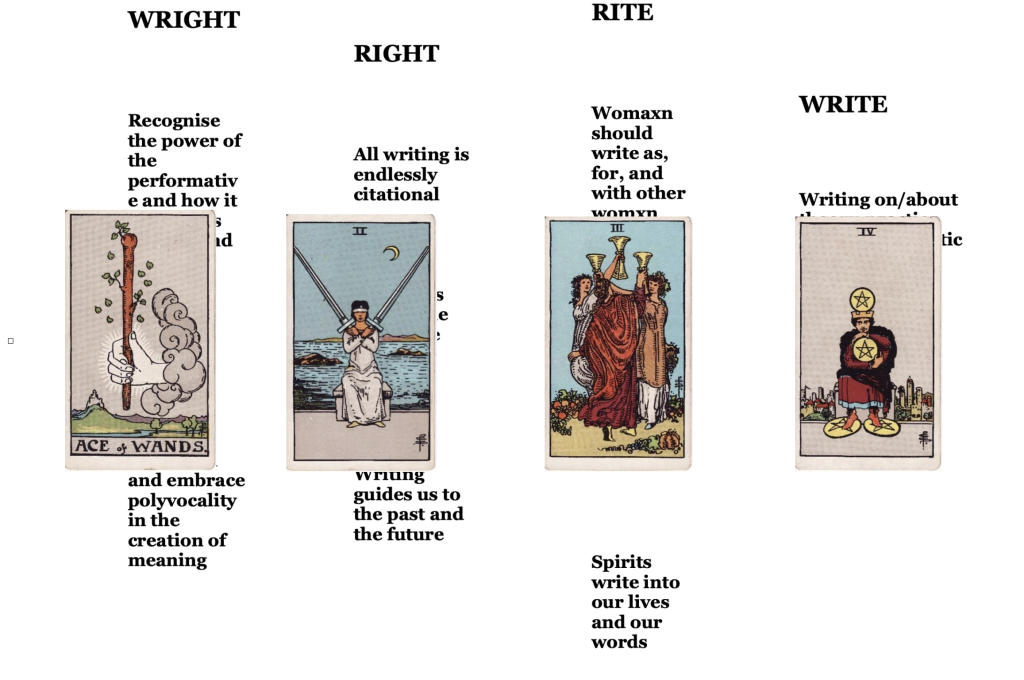
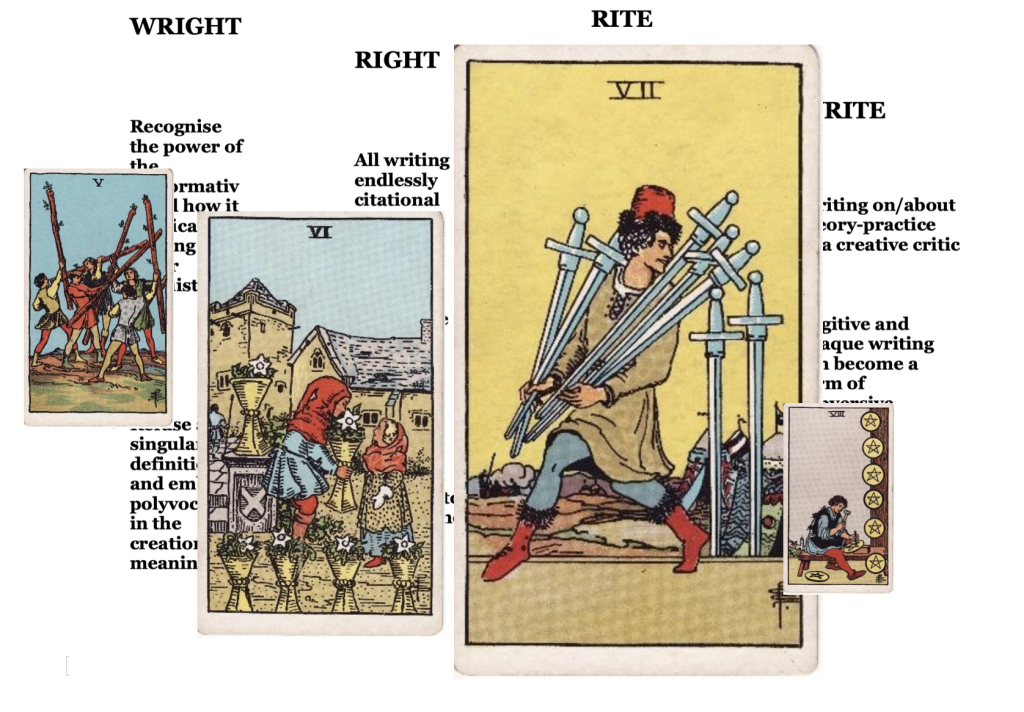
– Recognize the power of the performative and how it implicates writing and other linguistic acts. (~ 1 of Wands ~)
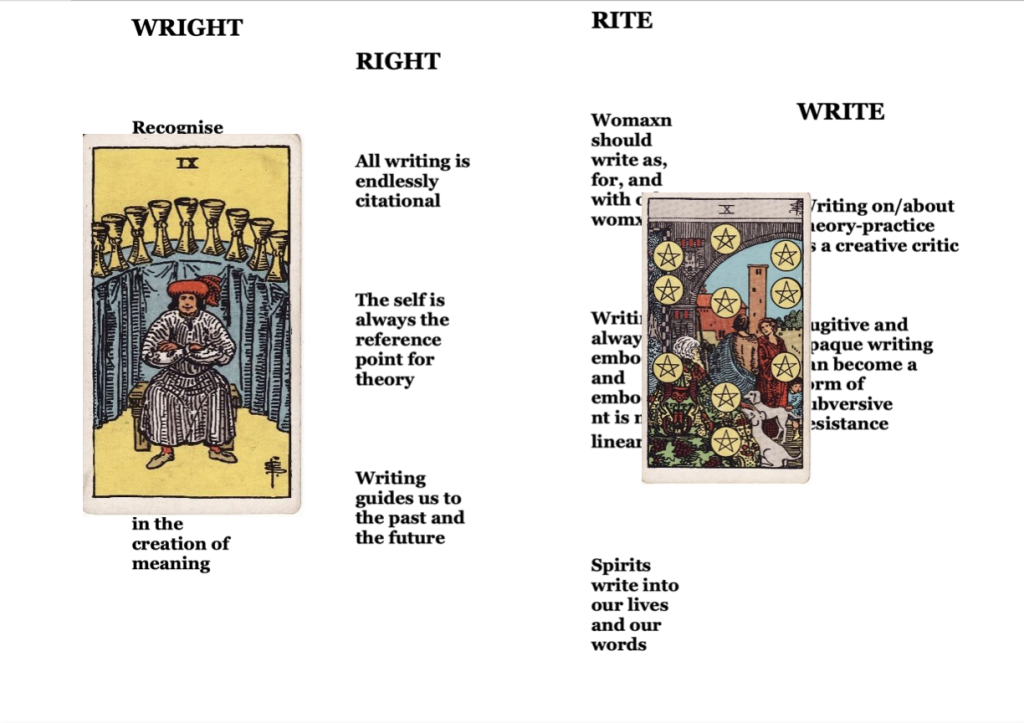
– Refuse a singular definition and embrace polyvocality in the creation of meaning. (~ 5 of Wands ~)
Right:
– All writing is endlessly citational. (~ 4 of Pentacles ~)
– The self is always the reference point for theory. (~ 8 of Pentacles ~)
– Writing guides us to the past and the future. (~ 10 of Pentacles ~)
Rite:
– Writing is always embodied, and embodiment is never linear. (~ 6 of Cups ~)
– Womxn should write as, for, and with other womxn. (~ 3 of Cups ~)
– Spirits write into our lives and our words. (~ 9 of Cups ~)
Write:
– Writing on/about theory-practice as a creative critic. (~ 2 of Swords ~)
– Fugitive and opaque writing can become a form of subversive resistance. (~ 7 of Swords ~)
______________________________________
Endnotes
- This writing follows the elemental and numerical system of the Minor Arcana in a tarot deck. There are 4 suits of cards – Wands, Swords, Cups, and Pentacles – and each suit has 4 court cards and 10 number cards from 1 to 10, each number holding different meanings. As a tarot reader I selected these number cards across the suits as my guide for this writing, and each card is accompanied with a sentence from Christopher Marmolejo’s book Red Tarot, of which the larger paragraph is included in the footnote for parallel reading. See Appendix A for illustrations of the tarot cards that guided this writing.
↩︎ - The full paragraph reads: “Our bodies have become far too cold begging for justice. We want power, and the fire has made us fearless. We are nowhere compliant. We rally round the flame and rebuke the terrible horror inflicted upon us. What will be left standing after the fires of revolution are centred on principle. Self- hatred has gone up in smoke. Sense the victorious spirit that has risen. With the Ace of Wands, envision the long pursuit of justice. We are to take the Ace of Wands and become liberatory leaders. The honesty of this leadership unsettles and motivates the reader to personalize social issues. The fire that fosters transformative change captures passion, frustration, and anger. With the Ace of Wands we find a power highly concentrated with a palpable intensity. We begin the pursuit of freedom with the fire born of the Ace of Wands, only to find an unexpected creative communion as the reward for our bravery.” Christopher Marmolejo, Red Tarot: A Decolonial Guide to Divinatory Literacy (North Atlantic Books: 2024), 45.
↩︎ - When writing directly about Barby’s work, I am adopting Barby’s spelling in her project which is intentionally opening the category of “woman.” See Barbara Asante, “That Bird Is Singing Us an Invitation to Meet Our Future: Listening to the Call of Sankofa to Develop Memory Practice Methodologies for Performative Practice”, Doctoral thesis, (University of Westminster, 2023): 84.
↩︎ - “A doppelgänger—an identical being who walks around claiming to be us, yet works to our demise as it unveils our mistaken identity to those who thought they knew us most intimately—is born from denial states. The Two of Swords arises when our doppelgänger does too. // Any autonomy, self-determination, and freedom that come at the cost of self-mutilation are falsely conceived. Liberation cannot mean liberation from corporeality. Attempting to annihilate the pain of our suffering, or to cover a tormenting past to the point that we feel unreal, disembodied, and split off, can never balance an awareness of love. To seek a self- determination that requires alienation from the body is to seek dominance of the head over the body, male over female, a poison lingering from Enlightenment thought. It’s a worldview at odds with a trusted intuition. But the Two of Swords is a signal that the logical path to inquiry is blocked.” Marmolejo, Red Tarot, 78.
↩︎ - Lauren Fournier, Autotheory as Feminist Practice in Art, Writing, and Criticism, electronic resource (Cambridge, Massachusetts: The MIT Press, 2021), https://ebookcentral.proquest.com/lib/UAL/detail.action?docID=6467674, 10.
↩︎ - I am referring to the title of the book The Creative Critic, edited by Katja Hilevaara and Emily Orley and published in 2018, which has the subtitle “Writing As/About Practice.”
↩︎ - I use first names for artists, writers, and friends that I feel close with, and I use last names for those that are more canonical in Western philosophical traditions.
↩︎ - “The construction and reclamation of spirited, celebratory spaces and rites confront the contexts of the civic, social, and psychic limitations imposed upon oppressed people. It is a continuous reworking of elements, finding how many harmonies we can make out of our sorrow, how much laughter we let out in our pain. The celebration of the Three of Cups is a spontaneous choreography of healing, dancing intelligence. If it seems there is no way to continue walking forward, then the Three of Cups asks us to dance through the dark to keep the faith. Jubilance is an instrument of the people. It transmits, summons, expands, and envisions. Our dancing, our celebration is a living prayer. From these memorial gatherings we keep from falling into oblivion, we dance our way into the future, or we ensure a future through our dancing. This dance is dedicated toward freer, unconstrained futures for all our relations. This Three of Cups conjures our ecstatic resilience.” Marmolejo, Red Tarot, 126.
↩︎ - The video documentation of the performance can be found at https://youtu.be/uWnT6129Dgk?si=BjMdIdy- qkE0ylXW.
↩︎ - These insights and what follows were kindly shared by participants in Barby’s project in a Unit 3 session for Mres Art: Exhibition Studies at CSM, organized by Louise Shelley on May 22th, 2024.
↩︎ - Asante, “That Bird Is Singing Us an Invitation to Meet Our Future”, 127.
↩︎ - Asante, “That Bird Is Singing Us an Invitation to Meet Our Future”, 84
↩︎ - Hélène Cixous, “The Laugh of the Medusa”, trans. Keith Cohen and Paula Cohen, Signs 1, no. 4 (1976): 875.
↩︎ - To find the occurrences, please read the full performance script shared by Barby and Louise in Appendix B.
↩︎ - Cixous, “The Laugh of the Medusa”, 880.
↩︎ - Ama Ata Aidoo quoted in Asante, “That Bird Is Singing Us an Invitation to Meet Our Future”, 117 and the performance script (see Appendix B).
↩︎ - It is also important to write more and remember what bell hooks said, “no woman writer can write “too much” because “no woman has ever written enough,” especially for those at the intersections of structural discrimination.
↩︎ - Gayatri Spivak discusses “speaking for” and “speaking about” in terms of the philosophy and politics of representation; Trinh T. Minh-ha intends to “speak nearby” instead of “speaking about” in her film Reassemblage to oppose ethnographic gaze; Irit Rogoff stresses how “writing with” challenges hierarchy of meaning-making in visual culture; and Jane Rendell explores the significance of prepositions in critical spatial practice.
↩︎ - Henry Borgdorf quoted in The Creative Critic: Writing As/about Practice (Taylor and Francis Group: 2018), 6, edited by Katja Hilevaara and Emily Orley. 8
↩︎ - “Readers of the Four of Pentacles learn to inhabit space in the way bell hooks learned to inhabit space. We are to become familiar with a particular location as we invest ourselves in that place of community and uphold the responsibility of that investment. We pull this card as an opportunity to renew our commitment to the body, to place and community. In this card we learn to speak the language of the Earth, and though we may journey far and wide looking for this seat to set roots, though we may endure changes imposed upon us by the decay and renewal of time, we will always belong.” Marmolejo, Red Tarot, 174.
↩︎ - A session of Unit 3 for Theory and Philosophy and Moving Image in MRes Art at CSM on April 16th, 2024, led by Duncan White, the course leader of Moving Image. ↩︎
- Giorgio Agamben, “Notes on Gesture.” In Means without end: notes on politics, by Giorgio Agamben, translated by Vincenzo Binetti and Cesare Casarino (Minneapolis; London: University of Minnesota Press, 2000), 59.
↩︎ - Della Pollock, “Performing Writing” In The Ends of Performance, edited by Jill Lane and Peggy Phelan (New York; London: New York University Press, 1998), 92.
↩︎ - I am making a reference to what Jacques Derrida has summarized as “there is nothing outside the text.”
↩︎ - One of the most important references in Barby’s “Declaration of Independence” is Ama Ata Aidoo’s poetry and, for the TfL rendition of the project, a photograph of Auntie Regina as a fluffer in the TfL archive became the focal point of this version. For more information on the creative process, see the documentary film at https://youtu.be/ILHjPru92C4?si=WEOhLw2T4V4Rt6PL.
↩︎ - Dwight Conquergood, “Performance Studies: Interventions and Radical Research”, TDR (1988-) 46, no. 2 (2002): 151.
↩︎ - Bryant Keith Alexander and Mary E. Weems, Collaborative Spirit-Writing and Performance in Everyday Black Lives, Qualitative Inquiry and Social Justice (New York: Routledge, 2022).
↩︎ - I am referring to the Research Excellence Framework (REF), which is discussed by Katja Hilevaara and Emily Orley in the introduction to their book The Creative Critic: Writing As/about Practice.
↩︎ - “To be made socially real, we need to risk reinvention, deconstruction, and presentation in front of a crowd. This crowd is certainly not always a chosen community, but the Five of Wands extracts a will to be seen and heard by those who we determine validate our entry into a given community or space. The risk is that our dream of a new or truer identity may be shamed, shaded, or still unrealized. The benefit is that the Five of Wands embraces the paradox of identity, the being of many things at once, the continuous redefinition of identity in social space, which affords the spaciousness to more fully be. The person who succeeds from the Five of Wands does so in recognition of the persona – from the Latin, meaning “mask worn by actors” – that is most compelling in any given social interaction. Our roles change by the hour, by the environment, and by those we play against or with.” Marmolejo, Red Tarot, 199.
↩︎ - Roland Barthes, “The Death of the Author” In Image, Music, Text, translated by Stephen Heath (London: Fontana, 1977), 142-148. This is probably the most canonical reference I have – how many times do you think this article has ever been referenced?
↩︎ - Michel Foucault, “Authorship: What Is an Author”?, Screen 20, no. 1 (1 March 1979): https://doi.org/10.1093/screen/20.1.13, 13–34. This reference also gives me a slight cringe.
↩︎ - Italo Calvino, The Uses of Literature: Essays (San Diego: Harcourt Brace Jovanovich, 1986), http://archive.org/details/usesofliterature00calv. 15.
↩︎ - Calvino, The Uses of Literature: Essays, 15.
↩︎ - Pollock, “Performing Writing.”
↩︎ - To know more about the voice of each name, see the performance script shared by Barby and Louise in Appendix B.
↩︎ - “We can use the card to transport into “timeless” states, although the memories mediated here offer radical transformation. Meaning bound by spatial, temporal circumstance is emancipated here. We carry on with the distillation of sensuous encounter, an embodiment of truth beyond the bounds of reason. The Six of Cups is an invocation of authenticity and a return to tradition as a response to destabilizing flux, displacement, and social disruption. It is a wormhole unveiling every entrance into the streams of time, summoning every profusion of possibility for relational selfhood to manifest in multiplicity.” Marmolejo, Red Tarot, 231.
↩︎ - Saidiya Hartman, “Venus in Two Acts”, Small Axe 12, no. 2 (2008): 2.
↩︎ - Pollock, “Performing Writing”, 81.
↩︎ - I am referring to Donna Haraway’s methodology of “speculative fabulation” and Saidiya Hartman’s “critical fabulation.”
↩︎ - “To create movement out of static caricatures we seize space, attention, and time from the realms we’ve been barred from or locked into; like Lauryn Hill, we get out. We deploy a strategic double consciousness and enact narrative insurgency. The contexts within which we work toward decolonization may differ, but we each endeavor to overturn the matrix of being, power, and knowledge that maintains colonial structures and consciousness. In seemingly inescapable dire socioeconomic conditions, amid impossibly tight constraints, a sly space of freedom is found by the Seven of Swords sensibility.” Marmolejo, Red Tarot, 268.
↩︎ - Louise is also the substitute course leader for MRes Art: Exhibition Studies leading Unit 3 at the time of writing.
↩︎ - Michel de Certeau, The Certeau Reader, edited by Graham Ward, (Oxford: Blackwell, 2000). 133.
↩︎ - Sonia D’Alto, “Confabulating with Shadowy Insurgent Spiritualities.” In Falling In: Movement and Becoming in Curatorial Research, edited by Dahlia El Broul, Ksenia Kaverina, and Jussi Koitela, (Mousse Publishing, 2024), 108, 110.
↩︎ - If you know, you know.
↩︎ - That is Euro-American, anglophone, and logocentric, with histories of political, socioeconomic and epistemic violences.
↩︎ - Alexander and Weems, Collaborative Spirit-Writing and Performance in Everyday Black Lives, 34.
↩︎ - I am partially referencing Hélène Cixous’ usage of the French word “voler” in “The Laugh of the Medusa,”
887, where it means both to steal and to fly.
↩︎ - I hope you know what I am referring to, but if not, I highly recommend you familiarizing with Maya’s poetry.
↩︎ - “There is constructive critical interrogation in the Eight of Pentacles. A focus, a critiquing eye that enhances and illuminates the work. It is an invitation to transform the ways of looking and participating with larger cultures while working at the margins. It considers both the subject and object of creation, one’s claimed cultural genealogy, the labor making the project possible and toward what end by whose vision. The pentacles they make are more than decoration; they are worlds within themselves documenting a personal history, displaying an artistry, recognizing a cultural influence. The pentacles are thus a commentary on legacy and impact.” Marmolejo, Red Tarot, 309.
↩︎ - Fournier, Autotheory as Feminist Practice in Art, Writing, and Criticism, 10.
↩︎ - Fournier, Autotheory as Feminist Practice in Art, Writing, and Criticism, 10.
↩︎ - Pollock, “Performing Writing”, 75.
↩︎ - Christina Sharpe, In the Wake: On Blackness and Being, electronic resource (Durham: Duke University Press, 2016), http://ebookcentral.proquest.com/lib/ual/detail.action?docID=4717126. I hope you are on the same page with me because we have to do this together. ↩︎
- “The Nine of Cups interfaces different worlds, deities, and the bodyspiritland. These interactions between seen and unseen forces that coexist in the material world are complex. It is a borderland of the mundane and the magical. The Nine of Cups crosses this threshold with prayer, an offering, in recognition of the guardian that dwells here. And we get to choose our guardian deity who receives our prayers, fulfills our wishes, and marks the passage of the temporal opening to eternity. “Dreams are a form of data gathering and method for asking for knowledge, just as are the ceremonies. In Native science or IK, dreams are ways that authority and authoritative knowledge are produced. To include dreams as part of an Indigenous science defies accepted agreements in much of Western scholarship about what is reality or a valid realm of knowledge.” Marmolejo, Red Tarot, 345.
↩︎ - Asante, “That Bird Is Singing Us an Invitation to Meet Our Future”, 2.
↩︎ - Asante, “That Bird Is Singing Us an Invitation to Meet Our Future”, 27.
↩︎ - Albert Kayper Mensah quoted in Asante, “That Bird Is Singing Us an Invitation to Meet Our Future”, 42.
↩︎ - Walter Benjamin, “Theses on the Philosophy of History”, in Illuminations, ed. Hannah Arendt, trans. Harry Zohn (Fontana/Collins, 1982).
↩︎ - Jacques Derrida, Specters of Marx: The State of the Debt, the Work of Mourning, and the New International (Psychology Press, 1994).
↩︎ - Denise Ferreira da Silva et al., “Another Image of Existence: Denise Ferreira Da Silva and Valentina Desideri on Their Practice of Poethical Readings, the COVID-19 Pandemic, and the Need for a Radical Reevaluation of Modern Politics. An Interview by Eve Katsouraki and Georg Döcker”, Performance Philosophy 7, no. 1 (22 April 2022), https://doi.org/10.21476/PP.2022.71381, 138.
↩︎ - Alexander and Weems, Collaborative Spirit-Writing and Performance in Everyday Black Lives, 1.
↩︎ - D’Alto, “Confabulating with Shadowy Insurgent Spiritualities,” 98.
↩︎ - Sonia Sanchez, “Haiku and Tanka for Harriet Tubman,” Poetry Foundation, accessed August 30, 2024, https://www.poetryfoundation.org/poetrymagazine/poems/146231/haiku-and-tanka-for-harriet-tubman.
↩︎ - “The old one in the Ten of Pentacles is the prophet of the political imagination. We see them foresee commonality as they peer back into history. The hope offered is defiant, extravagant. This prophet’s offering is a luxury like bread, a poetry that is for everyone. With this card we are reminded of the various altars of place that establish sacred geography, the places where our relationship to the world is renewed… We pull cards and come into common consciousness. Wherever we plant ourselves, we make vines of vital connection from the decaying ones of displacement, diaspora, and migrations. We plant ourselves and repair our lineages. From everywhere we now stand, innumerable trees will take our place. Our foresight will be the fruit offered new life.” Marmolejo, Red Tarot, 392.
↩︎