
SONIC COMMUNALITY
In conversation with Aliaskar Abarkas
Aliaskar Abarkas and Imke F. Gerhardt | November 2026
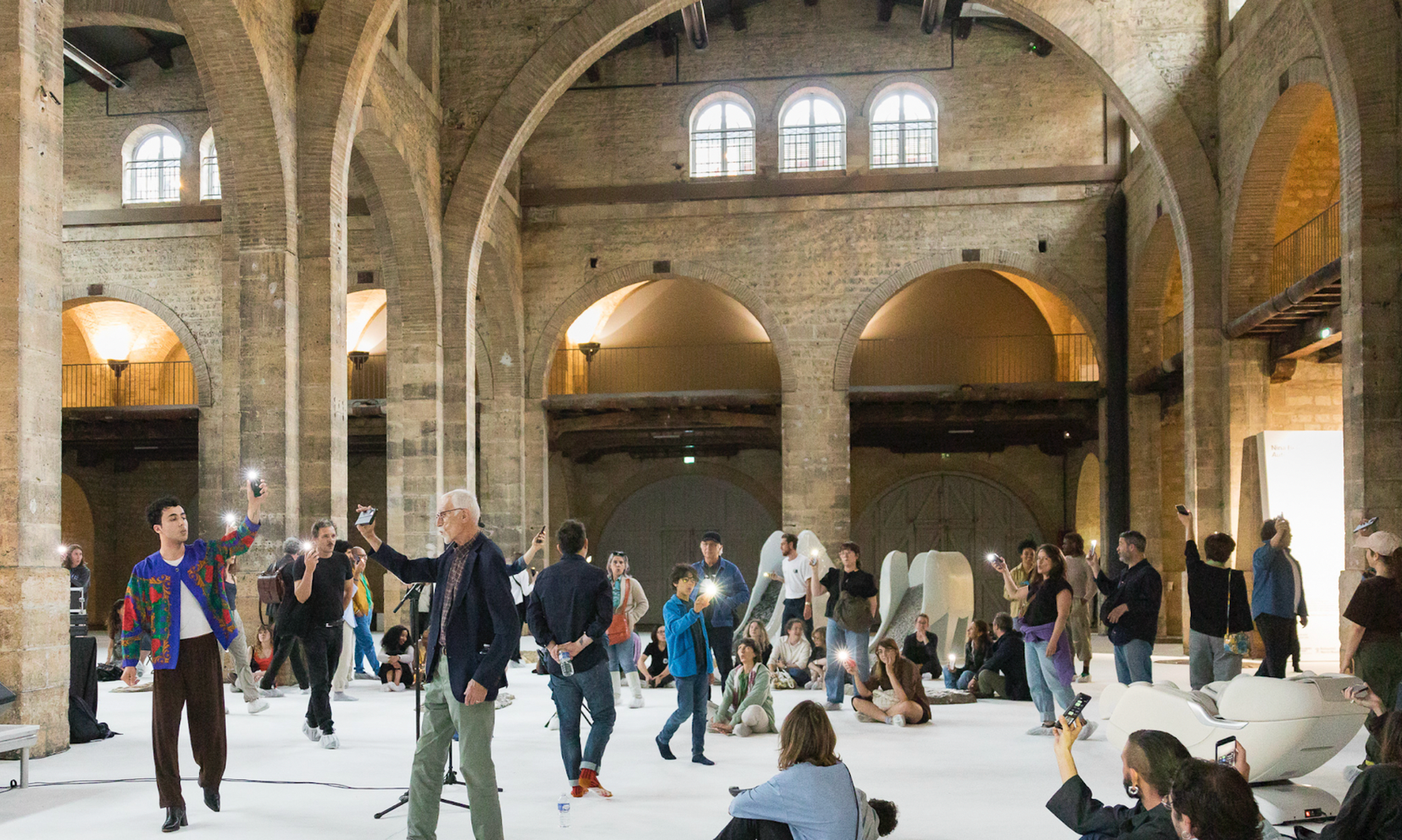
When do individual bodies become a group? And when does a group become something that exceeds the individual—a collective intelligence?
Political philosophy has long theorised the ways in which collective intelligence might surpass that of any single individual: the relational character of knowledge, the organisation of society, the conditions under which a collective can think, sense and act. From classical theories of the state—from the volonté générale—to more contemporary network theories, philosophers have imagined different models of an ideal community. Most of these, however, are grounded in verbal negotiation. They assume forms of linguistic exchange, resting on what Jürgen Habermas describes in The Theory of Communicative Action as communicative rationality.
But how does a group come into being when it suspends the logic of language? What kinds of collectivity emerge when people assemble through sound and rhythm rather than discourse?
Such collectivities are emergent, processual and fluid: temporary forms of self-organisation sustained through shared breath, shared vibration, and embodied sensation. They gather multiple individuals into a resonant body.
In this conversation with artist Aliaskar Abarkas, whose multidisciplinary practice moves across sound, performance, sculpture, film and collective forms of making, we focus on one recurring current within his work: the ways bodies are brought into relation through sound. We explore the immediacy of sonic connection, the new possibilities that emerge through relation, and how temporary communities might offer alternative ways of being together.

Imke: In recent years, much has been said about the atomisation and singularisation of contemporary society. While digital connectivity has rendered many of the temporal and spatial conditions of community obsolete, it seems, paradoxically, to have intensified experiences of isolation.
The communities that emerge online are largely mediated through language and images. Yet the body—which has the capacity to generate a profound sense of belonging through shared sensation—is often absent. The sensual dimension that enables us to connect with another body is not at the centre of digital forms of togetherness.
Before we speak about your practice of choreographing communal assemblies, I'd like to begin somewhere more personal.
What need or desire first led you to initiate these acts of assembly?
Aliaskar: I like people. Friendships are maybe the most meaningful part of my life — the support we give each other, what we learn from one another, the way another person can just shift how you see the world.
That feels especially true in London. I'm constantly meeting people whose backgrounds and histories are completely different from mine, and each of them carries a kind of knowledge I could never have arrived at on my own.
I think that's where the desire to make these assemblies comes from — wanting to build temporary conditions where those differences can actually meet. I often start by asking myself: what's the simplest thing a group could gather around? A whistle. A hum. A shared worry. A memory that's travelled between people, or across generations.
That small gesture becomes the medium — a reason and a structure for people to show up, listen, affect each other. I'm not trying to produce something coherent or unified. I'm interested in what happens when people who might never otherwise meet start exchanging ideas, sensations, resources — and find something none of us could have gotten to alone.
Imke: Globalisation and digital technologies have reinforced the feeling that everything is immediately accessible across time and space. As a result, mobility, transience and impermanence have become defining conditions of contemporary life.
Do you think the emergence of temporary communities is simply symptomatic of our historical moment? Or does the temporary itself hold a particular potential—a specific intensity, perhaps even a transformative force—that more permanent forms of community cannot generate?
Aliaskar: Temporary communities are partly symptomatic of the moment, sure. But I think the temporary also has its own potential. Because a gathering won't last, it creates a kind of intensity — for a short time people are actually present to each other, through voice, body, sensation, in a way that just doesn't happen online.
These can be really small feelings, things we forget easily. A breath, a sound, a shared memory — briefly, that connects people. And the simpler the point of connection, the more room it leaves for people to enter it differently. You don't need to share an identity, a language, a worldview.
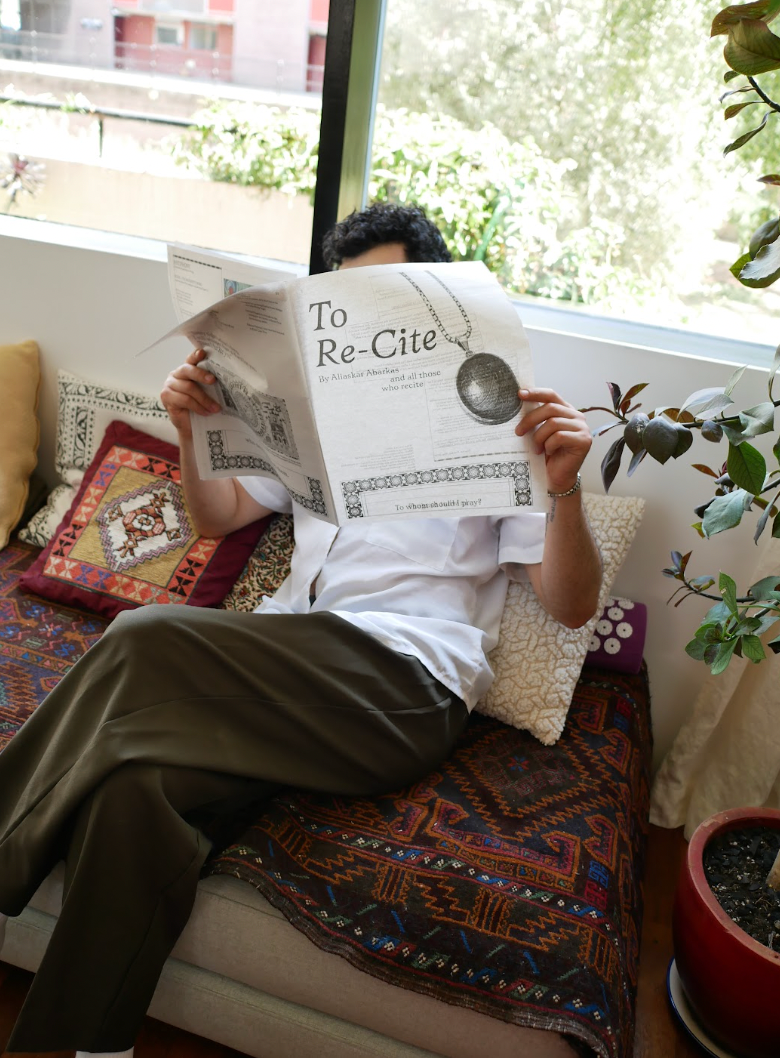
I've been thinking about this a lot through To Re-Cite, the project at Whitechapel Gallery. It began with Ayat al-Kursi — a verse a lot of Muslims grow up hearing, reciting, carrying with them. The people in the project came from different countries, spoke different languages, had very different relationships to faith. But there was something in the sound of that verse a lot of us recognised.
What it carried was different for everyone — protection, childhood, family, fear, comfort, belief, doubt. The gathering didn't make those experiences the same. It made a space where the differences could be heard, side by side. That's where I'd locate the transformative part. The community disperses, but something stays — an altered memory, a new relation, a sound carried somewhere else.
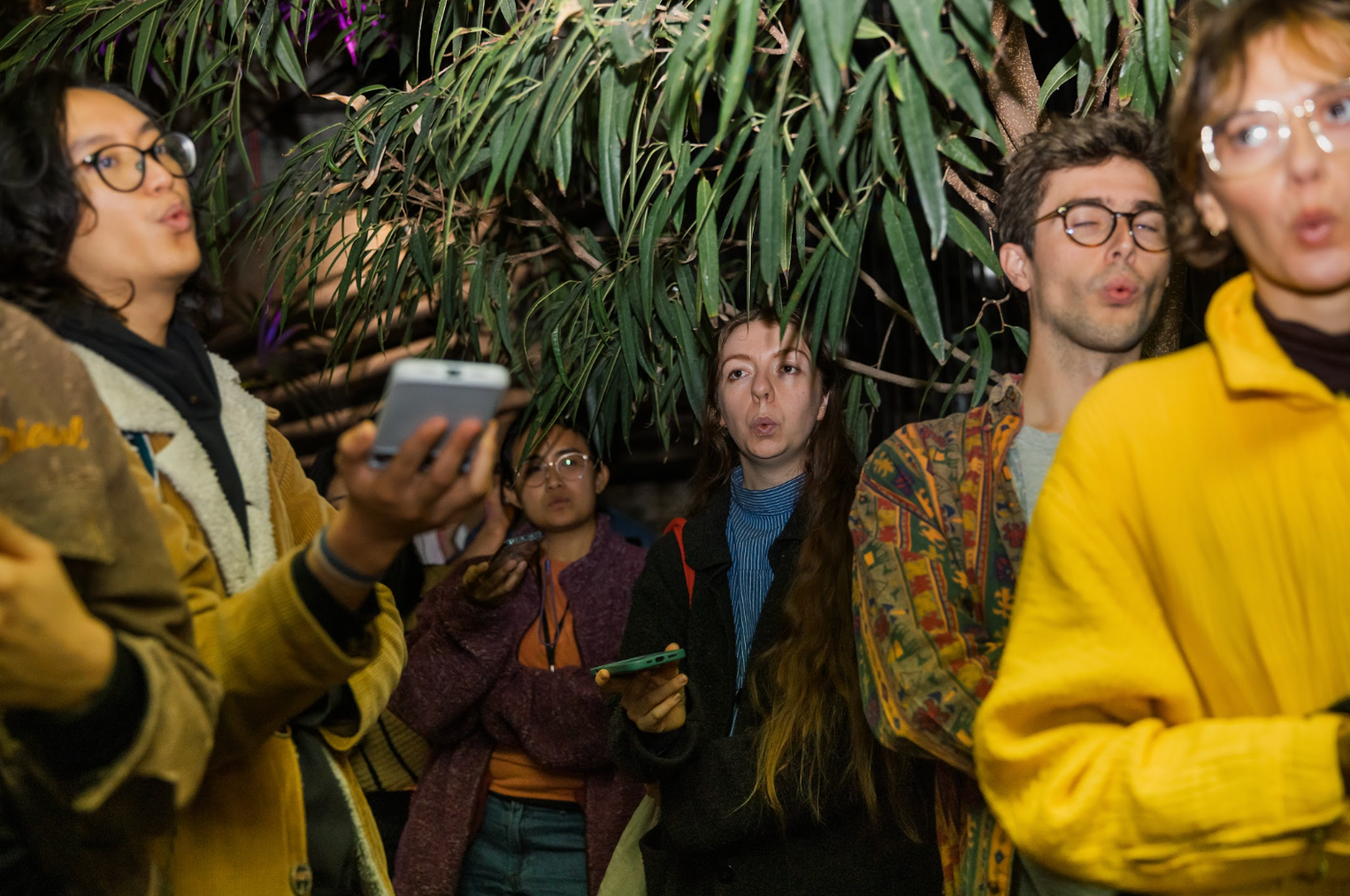
Imke: Movement and sound are, by their very nature, ephemeral. They disappear as they unfold, and perhaps for that very reason they carry a dynamic, anti-conservative potential.
Your work often explores the temporal and spatial organisation of groups through sonic practices such as reciting, whispering and whistling.
To me, reciting seems primarily temporal: it unfolds through repetition and duration. Whistling, by contrast, appears fundamentally spatial—it traverses distance, stretches across space, becomes a question of scale.
Whispering seems to inhabit both dimensions. It requires proximity and creates intimacy, yet it also gestures beyond the immediate present. It carries something spectral, invoking haunting, memory and the persistence of what has passed.
What draws you to these particular practices? And how do they function as choreographic tools within your work?
Aliaskar: Part of what draws me to these practices is that they're already available. No instrument, no training, not even a shared language required. They start with the body — breath, mouth, memory, listening. A small action can change how people occupy a room and how aware they become of each other.
Recitation's been part of my life since childhood — I trained as a qārī, reciting the Qur'an melodically. It teaches the body through repetition: when to breathe, when to pause, when to stretch a sound out or come back to a phrase. But I also feel it spatially. A voice changes as it moves through a mosque, a home, a public square — it can gather people around it, structure their attention.
Whispering comes from a more intimate place for me. My mother used to whisper Ayat al-Kursi before I slept, and blow it softly toward me — a kind of protection. Whispering needs closeness. It makes listening physical. And it carries a voice across generations, which is maybe where the spectral part lives for me — not as something abstractly haunting, but as one voice persisting inside another body.
Whistling works at a totally different scale. It can cross a room, a street, a landscape. It can be a call, a warning, a melody, a way of recognising someone far away. You can't always locate where it's coming from — it moves between people without quite belonging to anyone. A whistle can become a choir.
I think of all three as choreographic tools because for me choreography isn't only visible movement. It can be the organisation of breath, distance, attention, response. Recitation brings bodies into a shared cadence. Whispering pulls them close. Whistling spreads them out while keeping them connected. And these sounds don't just produce alignment — they produce hesitation, friction, drift too. The group doesn't need to move as one body. It becomes a collective by continually listening and adjusting to itself.
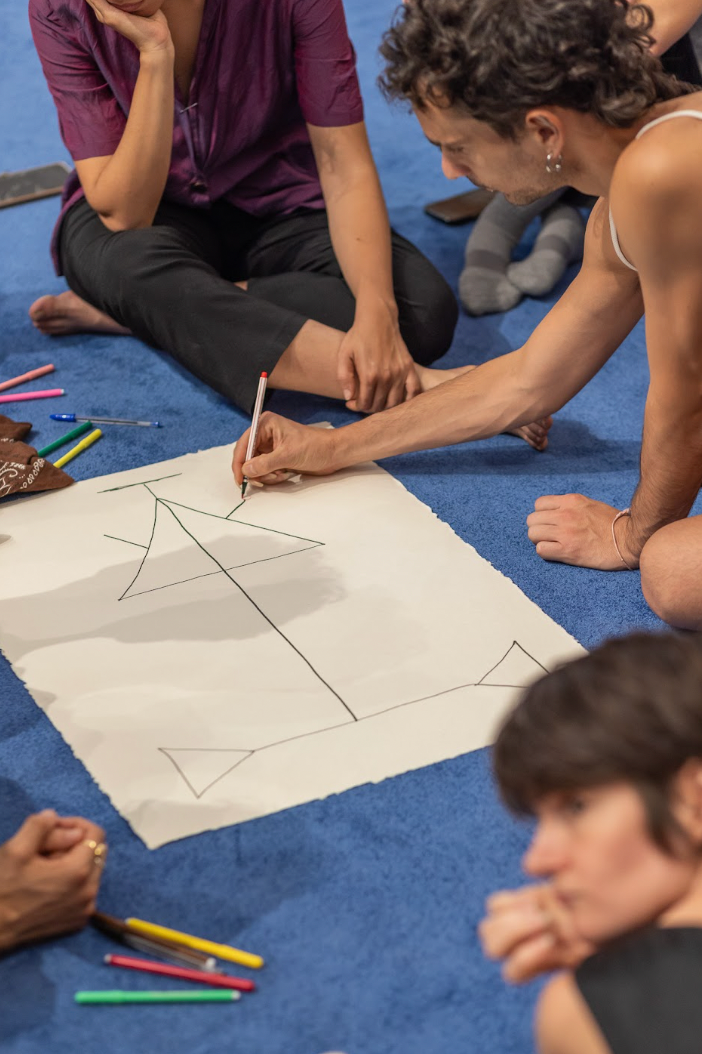
Imke: The repetitive structure of recitation has an identity-forming quality—not only for individuals but also for societies. These two scales, of course, continually constitute one another.
Judith Butler argues that identity is produced through performative citation, while culture itself is sustained through the continual repetition of norms and practices.
Unlike whispering and whistling—which largely operate beyond semantic meaning—recitation is often understood as a linguistic act. One might think, for example, of repeating an oath as a way of affirming truth or belonging.
In your work, are you interested in the semantic meaning of words, or rather in their rhythm, cadence and sonic materiality?
And do you think that shifting attention from meaning towards rhythm and sound also shifts the purpose of repetition—from affirming identity towards generating forms of embodied relation?
Aliaskar: I don't really separate meaning from rhythm, cadence, sound. I think they shape each other constantly. Meaning isn't only the dictionary definition of a word — it's also in how the word is breathed, repeated, remembered, who taught it to you, what was happening when you heard it again.
Ayat al-Kursi is a good example of this. A lot of people grow up reciting or hearing it without understanding every word of Arabic. That doesn't mean it's meaningless to them — the sound alone can already carry protection, childhood, family, faith, fear, comfort. The semantic and the sonic aren't separate for me. The words carry a religious and historical meaning; the cadence carries something more embodied and personal.
I'd push back a little on the idea that whispering and whistling sit outside meaning, though. A whistle can be a warning, a summons, a melody, a coded signal. A whisper can tell you it's intimate, or secret, or dangerous, before you've understood a single word. Sound is never neutral — it picks up associations from the bodies and places and histories that carry it.
Repetition can affirm identity, sure, but it can also reveal difference. No repetition is ever exactly the same twice. When people recite together you hear different accents, different breath, different hesitations, different relationships to what's being said. The group is connected without becoming uniform.
So it's not that I want to replace meaning with sound — I want to expand where meaning can be found. By paying attention to rhythm and listening, repetition can shift from declaring "this is who we are" to asking something more open: how are we together?
Imke: These temporary forms of sonic and sensual togetherness invite us to move beyond the imagined boundaries of the self. The idea of the autonomous, self-contained subject begins to loosen. The "I" expands beyond itself.
Through the collective production of sound, our internal bodily rhythms become synchronised. What emerges is a processual, immaterial form of collectivity—one constituted through energy, resonance and relation rather than fixed identity.
At a historical moment marked by identity politics and increasingly loud, confrontational assertions of the self, your practice proposes something quite different. It choreographs gentle, ritualised forms of encounter and collective becoming.
Do you see this as responding to a profound need of the singularised—and, if we follow contemporary research, increasingly lonely—subject?
And if so, might this itself be understood as a political gesture? Perhaps even as a practice of radical empathy?
Aliaskar: There’s a real need for spaces where people can be together without constantly having to present themselves, explain themselves, defend themselves. Loneliness isn't only about being alone. It's also the absence of situations where you feel your presence actually matters to someone, that you can affect them and be affected back.
I'd be careful about setting this against identity politics, though. For a lot of people, asserting an identity has been necessary just to become visible, to claim rights, to survive. My work isn't asking anyone to leave that behind. I'm interested in situations where identity is present but doesn't determine every relation in advance.
I'd also push back a little on "synchronised." In the gatherings I make, people don't always breathe or sound or move together. There's hesitation, refusal, silence, dissonance. Collectivity doesn't come from everyone becoming the same — it comes from the ongoing work of listening and adjusting while staying different.
Gentleness, though — I do think that's political. It's not passivity or withdrawal. Listening carefully, making room for someone else's hesitation, carrying a sound that isn't yours, letting yourself be changed by an encounter — these are political acts. They push against a culture that rewards speed, certainty, competition, individual visibility.
I'm a little cautious about "radical empathy" as a phrase, though, because empathy can suggest we can fully imagine what someone else feels. I'm more interested in attunement, or solidarity — being present to someone without claiming to know exactly what's happening for them. Maybe that's where the politics of the work actually is. Not dissolving the self into some unified collective, but feeling, even briefly, that none of us is entirely self-contained.