
Performing beyond the self
Cara Tolmie / Fernanda Muñoz-Newsome / Moyra Davey
Fay Nicolson | November 2026
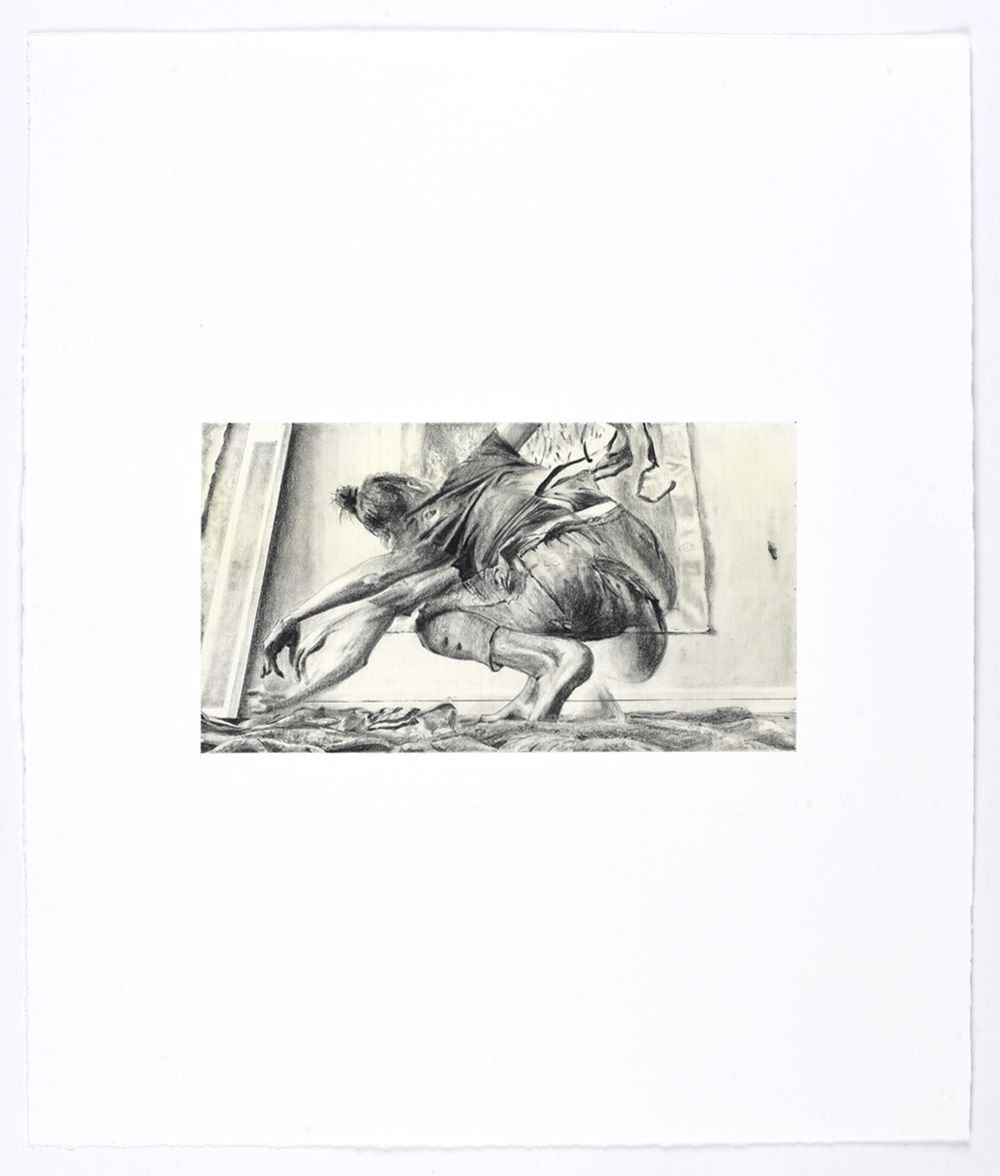
What does it feel like to sound — to vocalise? How can we listen to the bodily sensations that accompany each sonic expression, of ourselves and of the vocalising other?
Fay Nicolson’s text offers the most delicate observations of the sounding body, meticulously tracing every little tremor and vibration reverberating through the body.
A close-up of sensations, written in a visceral, fleshy language that at once precisely describes the sensations of this body in this particular moment, while coming so close to them that the observed and recorded sounds of the body become almost abstract.
Sound, in this text, is not merely described; it begins to speak through the language itself. The text seems to swallow, digest, and sound — almost onomatopoetically — so that language becomes less a medium for representing sound than a site in which sound takes place.
Reading, here, becomes an embodied act of listening: the minute sensations traced by the text begin to resonate with those of the reader, shifting attention from the body as something observed towards the body as something sensed, felt, and continously becoming.

1
I’m on my back on a soft play mat
My head is next to a student’s feet
I have been gurgling for three minutes
Water sparks from my gob
I have spit on my face
I swallow some of it
I am a humming machine a churning
clucking apparatus my cheeks ache and
I feel violated in a mint green way
like I might at the hygienist
I sound so that I will not drown
choke, cough, splutter like a naff fountain
there’s something joyous about this challenge
the debasement, on my back like a bug at work
2
My work spreads flat against surfaces, it is image. It appears on paper, canvas, screens, flattened and aware of this flattening – it wriggles against it, bunching the meniscus. Below this surface is the stuff of life (the action, error, wear, and terror) of making. The movement. I’ve long had a pull towards embodiment – to workshops involving dance, song, listening and play. I learn through these situations but also explore the aesthetics of these situations – an aesthetics of embodied learning. Workshops exploring voice and movement give me a way to enter into a creative flow state and grant me a refreshed perspective on the role of bodies as both makers and subjects of art works.
The workshops I attend often teach techniques drawn from movement, somatic or music pedagogy (Dalcroze, Action Theatre, Feldenkrais, Release Technique, Deep Listening, Embodied Anatomy, TRE and more). Though diverse, these practices each push towards an increased awareness of the possibilities and sensations of our bodies: awakening sensory perception and tuning in to how things feel as we encounter them. These things may be our environment (the cold floor, vibrato bird song), our relations (the guiding touch of others, the suggestion of a glance), or even our own insides (the tingling of fascia, the affective realm of our own imaginaries).
By learning to move and sound differently I stretch my image of myself as a human. I arrange myself in ways that scaffold, extend, unfurl. And having seen myself move differently, the register of other people’s gestures appears nuanced and enriched. This acquired somatic knowledge complicates designations between body and eye or mouth and ear. Allowing me to explore an aesthetics of somatic experience.
3
‘vocal somaesthetics will be interested in the bodily sensations of what it feels like to vocalize and to listen to another person vocalizing’
Anne Tarvainen. Singing, Listening, Proprioceiving: Some Reflections on Vocal Somaesthetics, from publication Aesthetic Experience and Somaesthetics. (Brill, 2018)
In Cara Tolmie’s workshop I pick a torn fragment of paper from the floor. Unfolding it I read it to my partner. Here I discover the phrase ‘somaesthetics’ taken from research gathered by Tolmie towards her PHD. To digest this quote we discuss how it feels to vocalize. We interpret somaesthetics as an aesthetics of bodily sensation – exploring the qualities of how things feel, trusting that our bodies are cognisant, or (to bring in a quote from my own research) to believe that ‘The body knows things about which the mind is ignorant.’ Jacques Lecoq, The Moving Body (Le Corps Poétique): Teaching Creative Theatre, 2013.
My partner and I think the trick to somaesthetics might be to focus on the inside of your own body when singing rather than remaining aware of how your voice sounds from the outside, of how it lands like a cold, disembodied artefact.
4
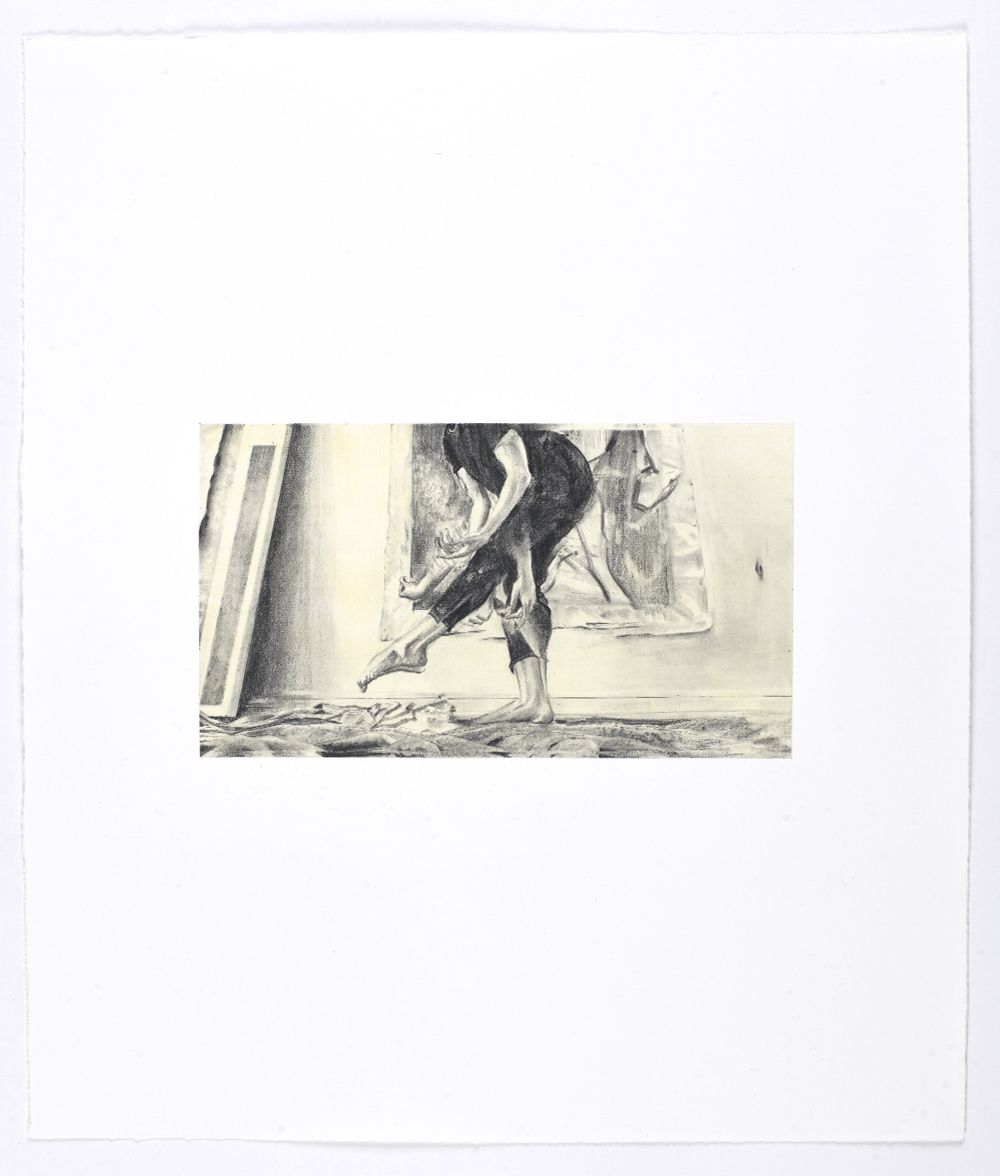
A few months ago I attended a morning class lead by Fernanda Muñoz-Newsome at Independent Dance. Fernanda used somatic and improvisatory approaches to facilitate solo and group movement. Towards the end of the session she introduced vocalizing exercises that drew on Meredith Monk’s methodology. Participants marked the bounds of a ‘stage’ with our bodies, choosing to enter one by one. Once inside we offered an improvised sound-gesture, that was to be repeated in a loop. As more people entered a polyrhythmic cacophony accrued. A tide of biological instruments, swaying, sounding, responding, clashing.
I just made up the term ‘sound-gesture’. Once you’ve executed one you’ll know what it is. It could be described as an action or gesture accompanied by vocalized sound, the two locked together as one entity. This choreographic/sonic form is locked into one unit that can be repeated, copied, layered. Monk employs them all the time as a way of foregrounding the link between voice and body.
‘I don’t really see a separation with the voice and the body. They’re one process. It’s the breath coming up through the body and out.’
Meredith Monk, ‘Behind the Scenes: Meredith Monk's Dancing Voices, Episode One’, video produced by the Lincoln Center, 2017
5
With nerves sparking my stomach
I tread towards the centre
joining two
I’m scouring my body-memory for something different
a missing texture or inflection
a counterpoint
I lunge and offer out a slow scanning arm
a low note is hooked to it and peels
through space
I want it to be open and generous and slow
another joins us
with each return I sense the
simplicity of my
sound-gesture groan
under my own weight
getting tougher and rougher and harder with each
repeat
another joins us and my groaning lunge
sinks to the bottom of the
living mix
I feel that lunge in one leg
accompanied by the ghost of my low drone
for days afterwards
an asymmetric fatigue
written in my body like a score.
6
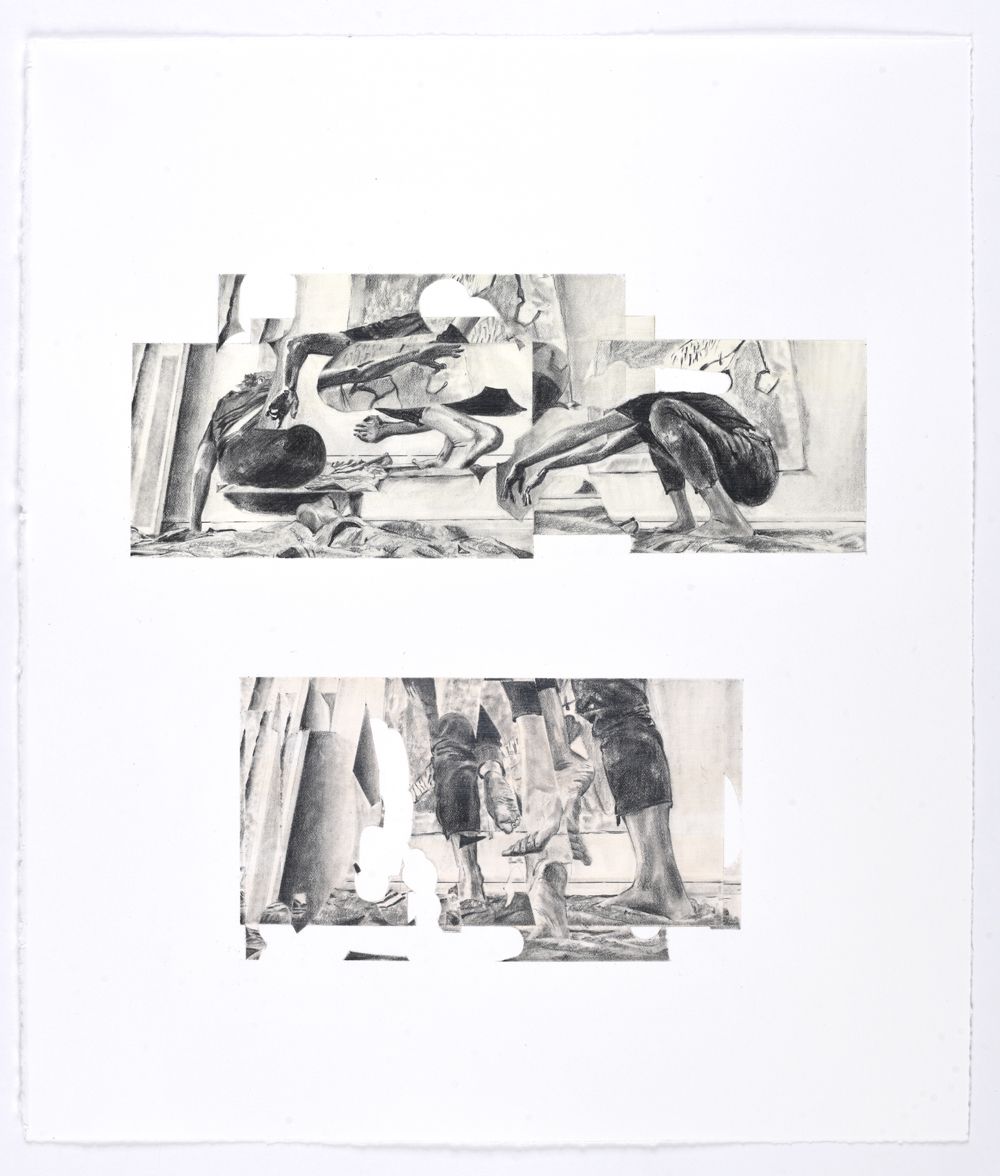
I invite Fernanda to lead a workshop with my Fine Art students. After this workshop I post a 5 second video of students moving together. I put a black and white filter on it. I don’t know why. Perhaps it places a necessary veil between the students and the screen, or between the real (with its fractal distractions) and the unifying theme of collective movement. Monochrome limbs glide and echo, responding, shifting across a space. When I post this I feel a shard of shame, emanating from the need to represent the moment.
Fernanda and I had been dancing together in the workshop, she was leading the group and we were demonstrating her instructions as a pair.
fingers twinkle down a spine
that reads and responds
my hand on her sacrum, flat, she is bent over
I sympathise with the moment she had her hand on my sacrum,
it felt really good, like being held in space
the pressure releasing something
a memory of my sacrum being pushed out of shape
during pregnancy and the slow pulling in of tendons
afterwards
I have one hand on her skull and one on the base of her spine
she is on all fours and I am low and catering
she unfurls and I have her spine between my hands like a creature
contained like an accordion, although it’s her spine that plays my hands
palms that follow and never force.
When we improvise together, guiding
I twirl around her toe and hold
I comb and flick an inner arm to the tips
I step back and witness, giving space
I realise I have not documented the workshop
my hair has been over my face
another convenient veil
I must step out of the moving body into the performing body
of the ‘teacher’
I observe, take in, open my camera app and capture.
as I peel away to record Fernanda comes out of her dance
it ends.
7
The facilitating body: there are networks of expectations to stoke and supply. The welfare of others to underwrite, you must hold the bureaucracy of institutions in your own body, hold that and meld it into something human sized for each of your students. This metabolic work is fuelled by your own psychic energy, funded by the hours you sleep, maintained by the calories you consume, and ballasted by the stabilizing care of others (the emotional shock absorbers).
8
At the beginning of Fernanda’s workshop she circulated a book containing images of a skeleton walking through a landscape, anatomically correct etchings from the Enlightenment period. We held these pages with our own bony fingers, observing this structure with sympathy and disbelief.
9
In her video Les Goddesses, Moyra Davey takes books from a shelf by their spines, blowing dust off them one by one out of an open window. Davey’s narration speaks of her Multiple Sclerosis and the homeopathic cures recommended for it (which also happen to be chemicals used to take and develop photographs). The body that makes and features in work is treated by the same chemicals that record it.
Embodiment, presentation, and performance of self, ricochet throughout the film splitting our attention and opening space for a porous kind of meaning making. A narration of Mary Wollstonecraft’s life crunches on 80’s monochrome photographs of Davey’s sisters. There are images of bodies being sorted by a body. Davey’s narrator figure slices the frame. Oblique and restless. We see her listening to her own narration on headphones and repeating this out loud to a zoom recorder. This slight, pre-emptive echo chatters under Davey’s in-person delivery, audible in a way that is disorienting.
I imagine how it would feel to be Davey performing this monologue to camera, her own voice flooding her ears as she repeats these words aloud. I feel queasy imagining this skewed stereo effect, of the strangeness of hearing one’s own recorded voice mixing with the resonant sound of your live voice as it vibrates through the bones of your skull towards your inner ear.
‘When discussing embodiment in relation to the voice–body bind, I refer to my sense of locatedness within the body - of how I experience and relate to my embodied self. This might be a feeling that I am wholly situated within my anatomy, or rather, I may also perceive a more disoriented sense of myself within it.’
Cara Tolmie, taken from the printed research materials used in her workshop, 2026
10
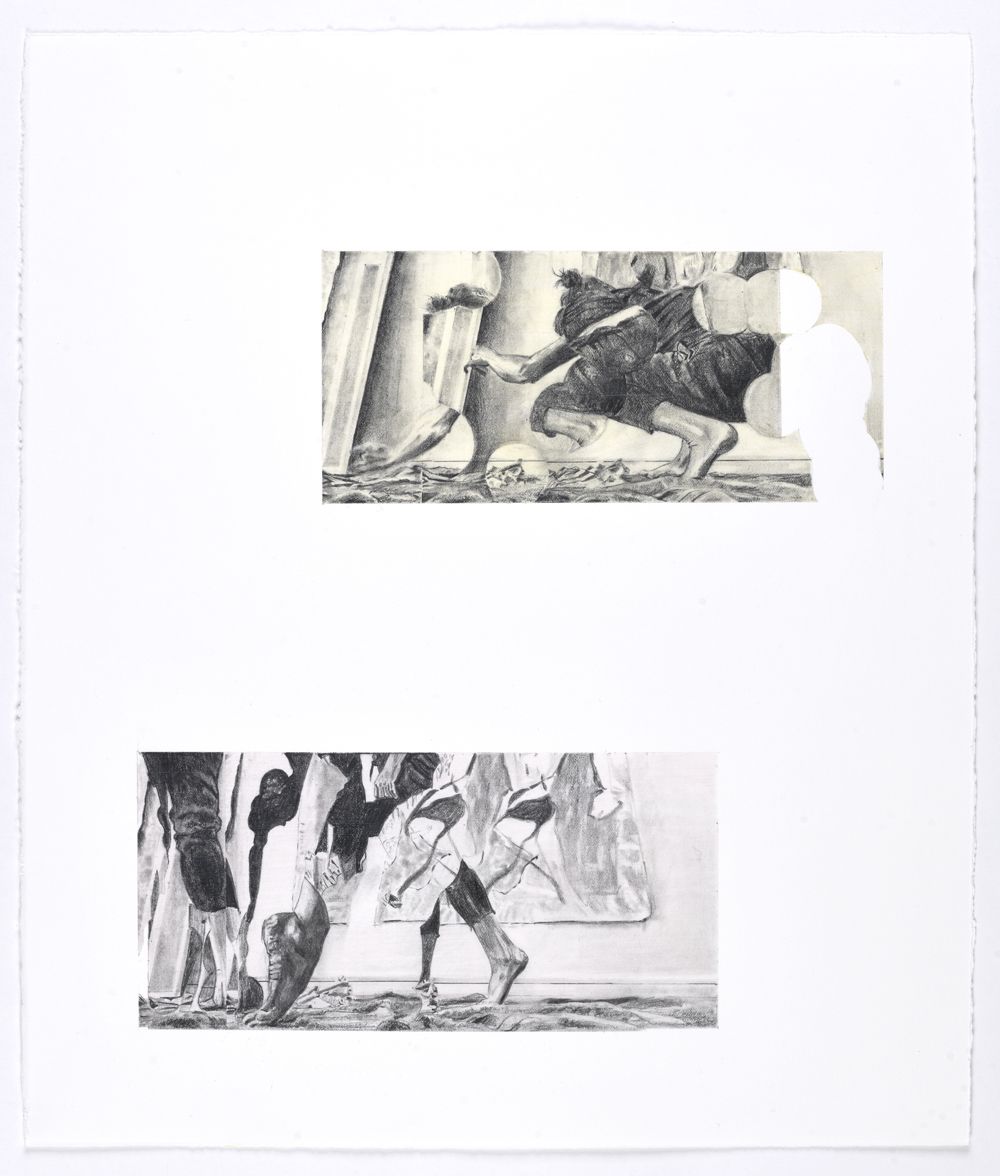
In the reading group after Davey’s screening people disagree on whether her film Les Goddesses is casually assembled or painstakingly self-aware, and what Davey’s intentions may be regarding her act of self-performance. Does she perform like this as a way to actualise or to dissipate the body? Or perhaps her performance addresses the trickiness of achieving either of these states.
The recorded word and image memorialise and make narrative possible, yet the act of recording escorts being towards appearing. I think of the photos I took in the voice and movement workshops, of the way they ossify experience and fail to capture the sense of sounding and moving from the perspective of the participant’s body. The images lack a quality of somatic empathy and do not apologize for it.
At home, my 18-month-old stands in a baby bath, she bends down to pick up her yellow duck. I have one hand on the base of her back. My palm covers half her spine. This scale feels unbelievable. How can something so seemingly fixed as bone be so open to growth and change?
…
Cara Tolmie and Fernanda Muñoz-Newsome lead workshops with BA and MFA Fine Art Students at Kingston University, March 2026.
Also discussed is a workshop lead by Fernanda Muñoz-Newsome hosted by Independent Dance at Siobhan Davies Studios, November 2025, and a screening and reading of Moyra Davey’s work programmed by the Feminist Duration Reading Group in residence at Goldsmiths CCA, March 2026.
___________________________

Fay Biography
Fay Nicolson is an artist and writer based in London. She is a lecturer in Fine Art at Kingston University.