
The Machine of Horizontal Dreams
Moving Discourse in conversation with multidisciplinary artist and choreographer Pepa Ubera
Imke F. Gerhardt and Pepa Ubera | March 2026
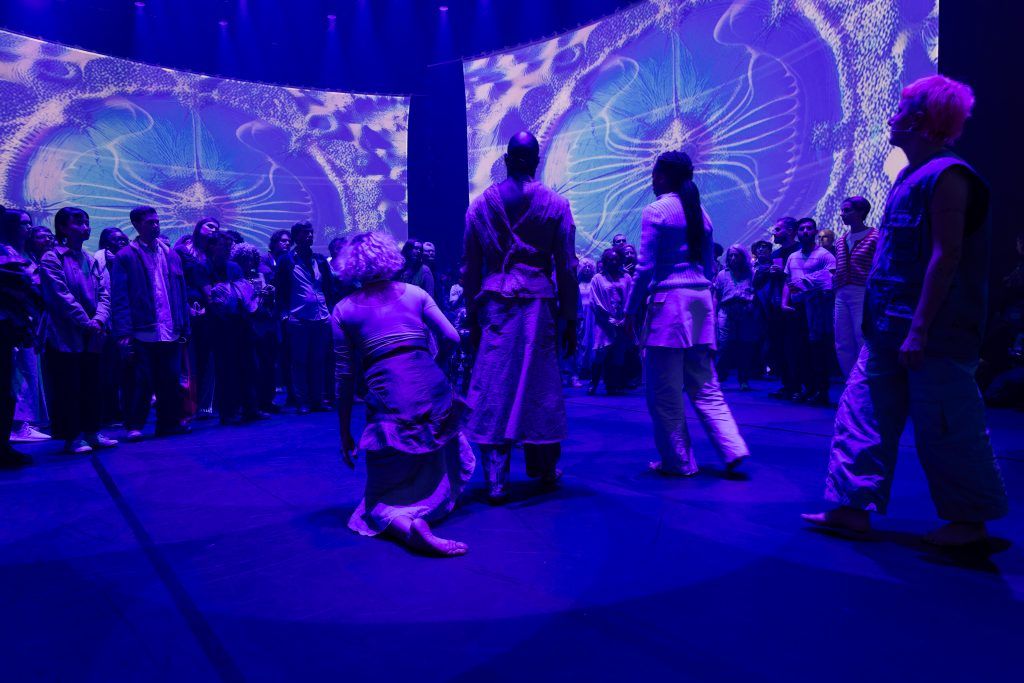
In the context of Chapter 1 – Desiring Elsewhere, Moving Discourse invited the choreographer and interdisciplinary artist, Pepa Ubera to speak about collective dreaming as a strategy of resistance, in relation to her most recent work The Machine of Horizontal Dreams. Premiered at Sadler’s Wells London in October 2025, The Machine of Horizontal Dreams is an immersive, interdisciplinary performance work that reimagines Western notions of progress through collective dreaming, ecological thinking, and embodied imagination.
Proposed as a living, breathing choreographic ecosystem, the work invites audiences into a landscape where slowness, pleasure, and relational presence become radical tools for rethinking of how we move forward together. The piece unfolds as a multi-sensory environment in which bodies and technology co-create new temporalities. Instead of progress understood as speed, extraction, and upward momentum, The Machine of Horizontal Dreams foregrounds cyclical, horizontal and interdependent forms of becoming. Here progress is felt, not measured; shared, not owned.
“I have a dream where my hard structures dissolve, where my bones, my joints my skull, my pelvis – all the hard and heavy parts, all fizzle away. And I’m left as an amorphous bag of tissues and muscle and flesh. Conscious and incredibly intelligent I slip and slide and snake my way through these landscapes.
I don’t have to worry about rent or work or food. I can be at peace with the joy of existence. I don’t even need to know the meaning or purpose of my own life.
My form is always shifting, always changing, never fixed , always transforming.
When I encounter new structures, all I have to meet them with is the softness of my flesh. I can be strong, held and squeezed, as well as soft, sliding and slippy.” – Jay Yule (Performer)
Imke: Let us imagine bodies not as discrete entities, but as porous thresholds – leaking into one another, hosting each other’s memories, and sharing each others rhythms. How do we create environments and a practice that attune us to the relational nature of our being?
Pepa: I am very interested in the idea of the body as a multidimensional landscape, one that does not hold frontal representation. For me, this is already a way of understanding the body as relational, as something that does not operate from a single direction but is constantly sensing, receiving, and relating.
Through this, I have developed a somatic practice in which the body is also a place that has no frontal representation or frontal sensing, but rather a multidimensional one. Therefore, it can think, sense, and operate as this multidimensional structure, allowing it to develop a relational approach to its reality. This also involves practising listening to the environment, making decisions, and letting go of the ones that do not serve the moment, whilst being confident in these actions and respecting the multiplicity of histories and experiences that form a single moment on earth.
For me, the context of thinking and working through performance installation is inherent to this idea. If we can operate in a space that does not have a specific direction to look at, to feel, to share, or to receive, then we can extend this way of sensing beyond the individual body and into the environment. The space itself becomes something we relate through, rather than something we look at.
Over the years, I have also developed a series of somatic and visual practices that attend to these principles. In a performance installation, I always think about the importance of social choreography: how we care for an audience, how we understand the context the work exists in, and how the work can invite others to be part of and co-create the experience with the performers and the proposed environment.
In this way, the environment and the practice are both working towards the same thing: creating the conditions for bodies to move away from a fixed, individual position and towards a more relational way of being together.
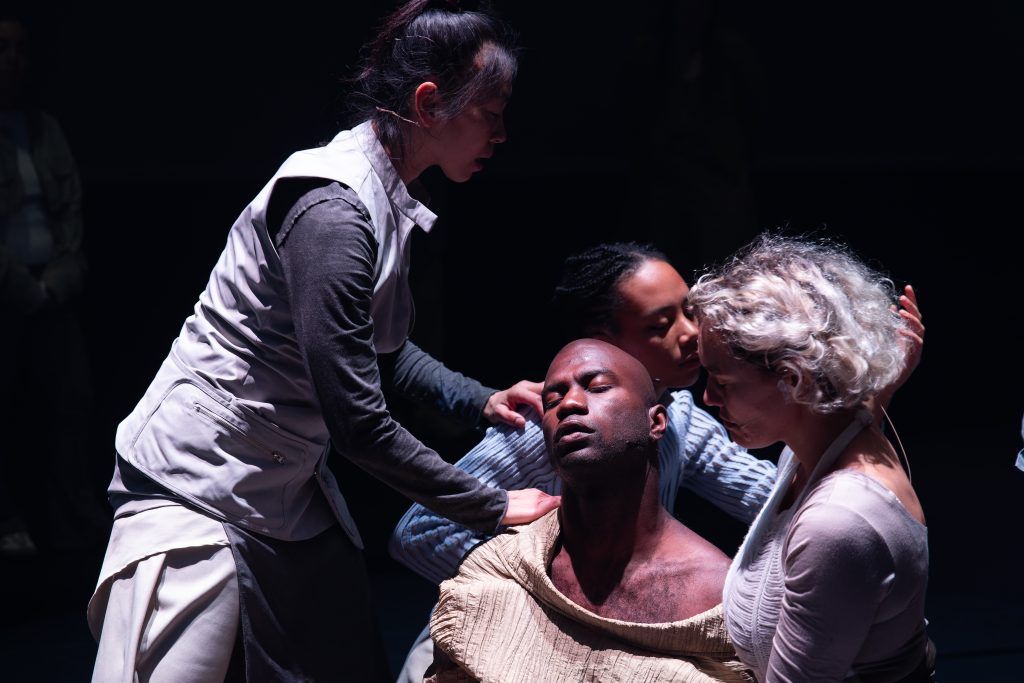
Imke: Working with a fluid understanding of boundaries and a non-static, relational conception of the self invites us to rethink autonomy and agency. Experimenting with dream-states seems particularly suitable for exploring these questions, as dreams allow for an altered experience of the self – one in which we relinquish control over narrative and direction. Dreams are non-linear and layered in their temporalities, often without a clear beginning or end.
In this work, you explore dreaming as a choreographic practice and I wonder: Can dreams have a choreography without having intention or authorship? What happens to agency when dreaming becomes communal and collective rather than individual?
Pepa: That is an interesting question, and I really appreciate the provocation within it. When I think about dreams, I think of both our subconscious – the dreams we experience whilst sleeping – and the dreams we formulate when we are awake. In both cases, intention, authorship, and the collective are already present. Even if we were alone on an island, we would still be in relation – to memory, to other lives, to the environment that surrounds us.
In my understanding of choreography as an emergent practice, intention and authorship are never fixed. They move, they shift, they are shared and reconfigured in real time.
So for me, dreams do have a choreography. The dreams we have at night, the ones we imagine, and the ones we conjure together. There is always a form of organisation, even if it is not linear, even if it escapes control.
I don’t think that collective dreaming removes agency, I think it redistributes it. It softens its edges, allowing it to circulate. What if we had more spaces to dream together? I believe that within those spaces, many of our dreams would already be aligned. There are things we collectively long for, even without speaking about them. For example, a shared desire not to be part of violence, not to be part of war. This, for me, speaks to the power of the collective.
In my choreographic practice, I am interested in creating conditions where authorship can be shared, where supporting someone else’s dream becomes a source of pleasure. There is something very powerful in witnessing the realisation of another person’s vision, in allowing it to exist and to transform you.
Through emergent scores, I work with structures that allow agency to fully arrive, and also to be released – to make space for another. In this way, leadership is constantly shifting. Ideas are developed, transformed, and dissolved. The work remains in a continuous state of flux.
Change is what prevails, and change is what we nurture.
I often return to Octavia Butler’s words:
All that you touch, you Change.
All that you change, changes you.
The only lasting truth is Change.
God is Change.
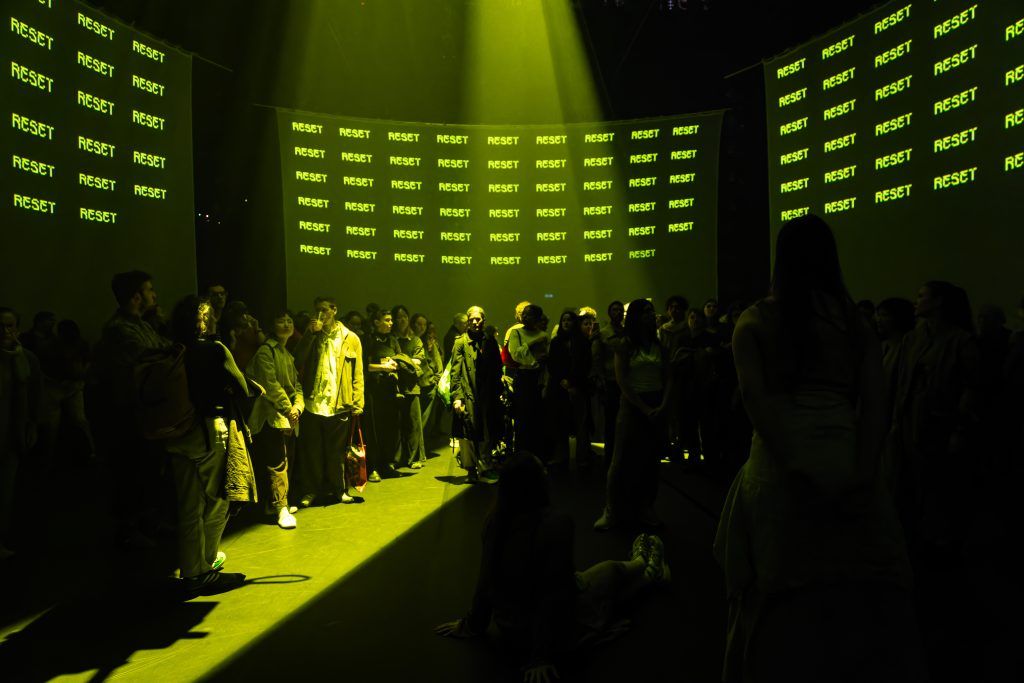
Imke: By allowing us to imagine alternative realities, dreams – and collective dreaming in particular – can become a strategy of resistance. Utopias are collective, social dreams, built on a desire for systemic change. In that sense, collective dreams carry ethics. How are these ethics negotiated on a bodily level” How do bodies recognise that they are dreaming together?
Pepa: I was already thinking about this question in the previous one, so for me it is a very important place to be.
I work with communities, and I am very fond of working with elders, as I honour their experience and their bodies. They hold a very specific richness that speaks of experience and knowledge, and I find that very inspiring.
For this project, I created an intergenerational group of performers, from LCDS students in their early and late twenties, to a community of elders aged 67 to 80, and a smaller group of participants in their 30s and 50s.
For me, this is already a way in which ethics are negotiated on a bodily level. Different temporalities, different histories, different ways of sensing and moving are present at the same time. The work becomes a space where these differences are not flattened, but listened to, held, and allowed to coexist.
I think bodies begin to recognise that they are dreaming together through attention – through listening, through being affected, through allowing themselves to shift in relation to others. It is not something that needs to be declared, but something that is felt. A kind of shared attunement that emerges over time.
In that sense, ethics are not imposed, but practiced. They are negotiated moment by moment, through presence, through care, through the willingness to be changed by others.
“I have a dream where my blood is really heavy and it is the heaviest thing about me. Just this thick bright red liquid that’s gushing , flowing , falling from my heart down out everywhere and my muscles and my bones and my skin are much lighter than anything, than us. The blood is the heaviest thing about me and everyone can see it and everyone can hear it and I’m beyond normal human form.” – Elisabeth Mulenga, performer