
Avatars vs. Ghosts
Gian Singh Sanghera-Warren | November 2026
Never pure, presence is, as Jacques Derrida notes, always haunted by what is absent. Traces of what could have been, and of what has not yet come to pass, disturb linear conceptions of time. Gestures of return and memories of the future mark the strange experience of our being.
Derrida invoked the ghost to approach the inapproachable — that which escapes our grasp and refuses representation: ghosts as the trace of the Other. In an age of deepfakes and augmented reality, in which avatars fill stadiums, we might reconsider how we think about and live with echoes of the past that reverberate into the future.
The choreographer and researcher Gian Sanghera-Warren reflects on the relation between avatars and ghosts by taking us on a journey — first to Derek Jarman’s cottage in Dungeness, and later to ABBA Voyage, a concert featuring virtual avatars of the Swedish pop group ABBA. Drawing on Mark Fisher’s continuation of Derrida’s thought — Fisher used the concept of hauntology to describe a society’s nostalgic fixation on lost futures, endlessly sampling past aesthetics — Gian translates Fisher’s ideas into the present. His vivid descriptions of these visits are full of observations on how people respond to what they cannot touch, yet still feel. These responses reveal that our nostalgic fixation is less about aesthetics than about emotion. And because we react so deeply to the traces of the Other — which, in our time, suddenly become visible through the spectral presence of the avatar — we might recognise our encounter with virtuality as one of the central ethical questions of our age. Avatars vs Ghosts

Ghosts
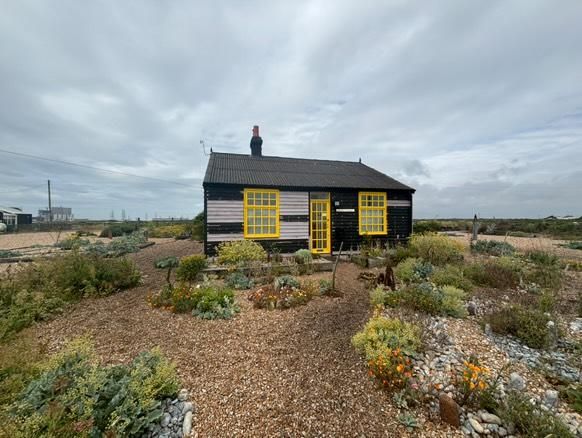
On the first weekend in July, I took a trip to the late Derek Jarman’s cottage in Dungeness. A humble black fisherman’s house, licked with yolk yellow paint around its windows and door, boasts an immaculately arranged garden, assembled and kept by the prolific filmmaker, artist and writer until his death in 1994.
As we pulled up to the cottage, followed by a group of Dutch tourists who seemed more occupied with the parking etiquette than visiting what has become a queer pilgrimage site, we noticed that on one flank of the house, half of the matte black planks had been removed for repainting, leaving pixels of naked grey in their place. Grey, as if reflecting the tones of the shingle beach, spitting clouds and the severe-looking nuclear plant that looms close by. The house had let its walls down, appearing in flux, dancing between time and resisting age, determined to look as if Derek might appear at any moment, birdwatching through one of its marigold windows.
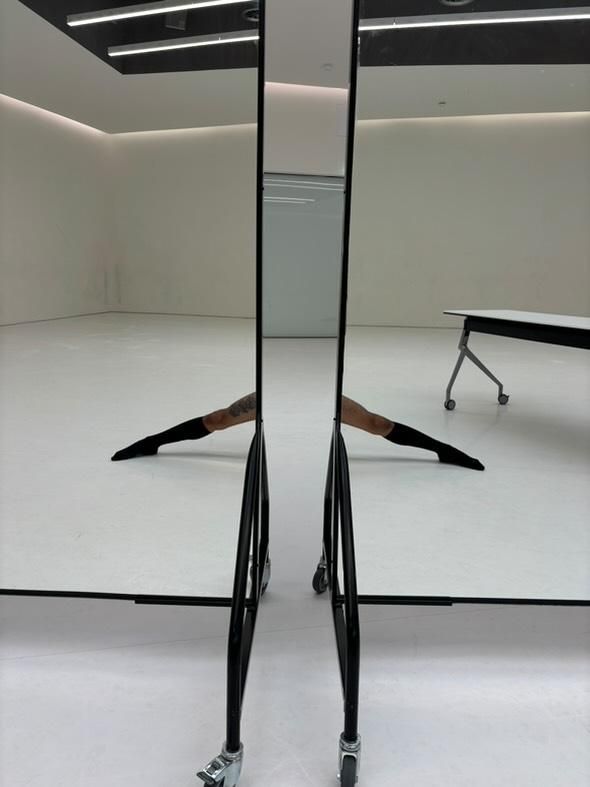
Dance artist Monika Błaszczak perceives time “as a spectrum to which moving bodies are subjected…represented as a figure of a ghost”. Ghosts are phases: different iterations of the body in time, which impact the present body, such as trauma or the ghost of capitalism. We can address these ghosts in a number of ways: through reading, mourning, learning about the impact of these ghosts, rewriting the “texts that constitute you”, and perhaps choreographing. In the end, we are nothing but ghosts dancing through time.
We stood on Dungeness beach, beaten by the wind, and I subjected my family to an extract of Pharmacopoeia, a collection of Derek’s writing related to the lore of Prospect Cottage and a detailed catalogue of the plants found around it: a spellbook of sorts. In the foreword, the actress Tilda Swinton writes about the day she and Derek discovered the cottage, having abandoned a hunt for a bluebell wood that had been paved over with concrete.
We followed Tilda and Derek’s movements like choreography: driving along the shore, stopping to skim stones and searching for pebbles with perfect holes in them. According to Tilda, Derek “would prefer his works after his death to evaporate and disappear”. Prospect Cottage defies that wish, not a graveyard but a playground for the ghosts of Derek’s characters and friends to dance and play, skimming stones and hauling rusted iron artefacts from the shores.
The cottage had lived in my imagination since I watched Caravaggio with my mum as a teenager, and it surprised me that it didn’t exist in isolation. Despite the infamous bleakness of Dungeness, a small community of similar and more elaborate houses line up along the shingle coast. Derek had neighbours. (In Pharmacopoeia, he mentions them, the boy next door firing his air rifle at the setting sun.) Instead of compromising the romantic image of Derek standing alone, overcoming the brutality of the Kent shore as he grew sicker, I enjoyed the fact that such concentrated magic could exist within the ordinary, that ghosts could dance among us.
I sit at each position for an hour in the gallery and 30 minutes in the car park. My favourite post is by the cars arranged in a cross in the cool shade of the concrete. I sit with my legs pulled up to my chest, deeply professional with headphones on, ignoring whatever podcast I have downloaded to watch the reactions of each visitor.
The artist known as Temporary Pleasure describes the work as “Four cars… each rooted in a distinct car-meets-music scene, become portals through time and sound”. I got to chat with John (Temporary Pleasure) after a rehearsal once. He told me that he would usually rather go to a fairground than an art show, and the installation captures that: the sensory overstimulation and frenetic play of the dodgems. Each vehicle is uniquely salvaged, hacked and rewired, with sound developed by four dance music collectives that transport visitors to distinct cultural scenes. The score begins with a loud revving sound, a throwback to the Transformers film franchise, as if the cars are about to spring to life and save the world alongside a pubescent Shia LaBeouf.
Some people barely stop to engage with the work; it’s too noisy and abrasive for them. Others placidly read the placard descriptions of each sound crew with the torch light of their phones before walking towards the carpark exit, eager to be greeted by the sunshine of the lake terrace. But now and then, a group of people let loose. Ravers, young kids, seemingly retired partygoers and tourists who might be inspired to end their weekend away at Fold (or Fabric). It feels voyeuristic to watch, but it’s hard to resist as a couple in their thirties bounce against each other, and I can picture a younger them clearly, meeting on the dancefloor of a garage rave in the early-2010s.
I’m seeing ghosts again, as the space clears out, air crisp with sweat and the dampness of the underground. Ghosts of dances that happen all the time, infinite movements and interactions that are waiting to be embodied.
Avatars
January 23rd, Pudding Mill Lane.
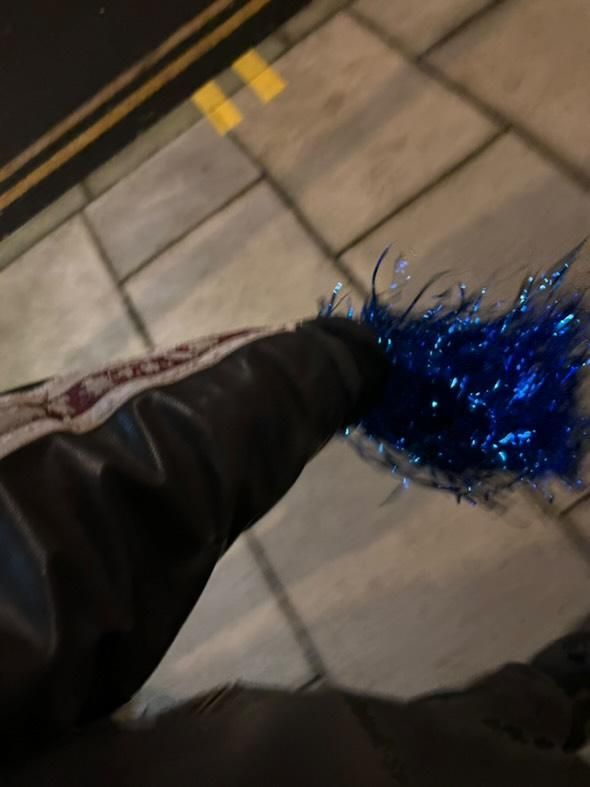
I traipse with my family around the full circumference of the empty London stadium, travelling out of the way of the shopping centre to arrive at a warehouse by the river. Knocking back a glass of draught margarita, my mum assembles a series of multicoloured foil wigs which we assign amongst ourselves, half-heartedly attempting to match with our outfits. A drunk woman on her way to the toilet is captivated by our shaggy tinsel bobs, stopping by for longer than is comfortable to coax my dad into wearing his Oompa-Loompa green wig.
An hour later, we are leaving the wooden scaffolding of the arena bar, plastic wine glasses in hand, to pass through the neon-lit spaceship tunnel into the main auditorium. We are reminded again not to take any photos, a rule I will later break, much to the disdain of the two women beside me. Having opted for the less extortionate standing tickets, we end up close to the stage, sandwiched between the aforementioned superfans and an unimpressed-looking group of teenage boys who appear to be on some kind of elaborate school trip.
The show begins.
Abba Voyage boasts a 4.9 star rating on google maps reviews, a rating it deserves, not for its innovative technology or for the drunken camaraderie it inspires on a once stale DLR journey from Stratford to Pudding Mill Lane, but for its ability to capture a dominant desire of our current time: to revive the ghosts of the past through the lens of the now. AV allows us to bear witness to a nostalgic time, immortalised in the state of the avatar – a desirable form for anyone who wants to transcend the archaic limits of past, present and future.
In 2012, Mark Fisher expressed that there was a stagnation within culture, a death of all things new, with media coming out of the 21st century being haunted “not so much (by) the past as all the lost futures that the twentieth century taught us to anticipate”. Late capitalism, post-modernism and neo-liberalism had killed all dreams of a radically new future, forcing music, film, literature to instead express a “pining for a future that never arrived”.
Abba Voyage literally offers a stage to the ghosts of the past, a band whose success at the 1974 Eurovision song contest catapulted them into international success during an era where the possibilities of music and culture seemed uninhibited. As avatars, the band hit the jackpot once again, earning over $2 million a week, scraping back the $175 million budget that made it one of the most expensive live music experiences in history.
Whilst the timing of Abba’s virtual reunion proves commercially inspired, it presents a version of modernity that lives up to Fisher’s narrative: a time where we are entertained not by possibilities of the future, but relics of the past and how this continues to prevent us from dreaming of newness.
As an audience member, we experience the transition from ghost to avatar, the sculpting of a human body with the ephemera of the past. After all, this was the process: using motion capture suits to record the movement of the band members as well as a series of younger body doubles, choreographed by dance and technology giant Wayne McGregor. Striking a balance between the live and the simulated, Abba Voyage is a thought experiment wrapped in the thick sticky glow of a boozy night out.
March 15th Sadlers Wells East
Age of Content was created by the National Ballet de Marseille, under the direction of arts collective LaHorde. The opening of the show features a sea of teal-clad GTA characters engaging in a brawl of carefully constructed hand-to-hand combat on board the skeleton of a remote-controlled truck.
Soon after, an NPC avatar takes centre stage, dressed coherently with the opening section in a velvet juicy couture tracksuit which, inside sources reveal, is inbuilt with butt pads. Face no longer disguised with net hood, the figure floats, scouts, aims and fires across the stage, joined by an army of individually styled avatars, performing a series of repetitive gestures, triggered, it seems, by an invisible controller – the bodies as motorised as the truck that steers and bucks moments before. The work is a meditation on the multiplicity and synthesis of the virtual and physical world. Nothing lasts quite long enough; the chapters are disjointed, style triumphs over substance, all of it deliberate. The structure of the work feels like scrolling through a content page, and the viewing experience is bumpy and borderline edging.
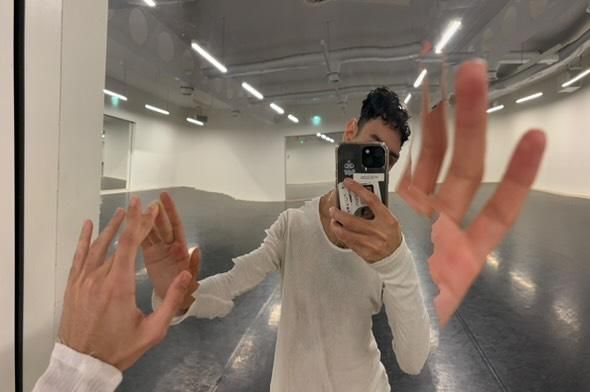
Discussing the video game Second Life as a performance of the virtual world, Koski suggests that “The performer-avatar relationship is characterised by the experience of agency: a performer controls the avatar’s actions, which, in turn, is a representative of the performer in the virtual world”. In Second Life, the avatar is “an empty shell, which can be charged with different gestures … a new surface for a performer’s expression”. Performing as an avatar subverts this; the body of the performer emulates the motion of a mindless virtual form. It’s an act of unconsciousing.
The avatar, in many ways, is the ghost reimagined. Simultaneously embodied and disembodied – a version of the self, deconstructed, observable through some sort of augmented view – the screen or stage as a curtain to the underworld.
I marvelled at the work of Nina Davies at Matts Gallery in 2023, who presented a live experience of three performers-as-NPCs, weaved around a fictitious court-based narrative so complex I had to watch the video three times. In comparison, the NPCs of the National Ballet de Marseille, despite the skill of the performers, no longer felt urgent just two years later. In a trend cycle that has permeated the world of dance, it seems impossible to propose a new idea. The NPC no longer appears as an avatar as intended but instead transitions into a ghost. Repertory work is another perfect playground for spectres. With each performance of the piece, the audience is haunted by an idea tied to a distinct time within dance-world lore. Trend cycles in general exist as a form of ghosts themselves, neither fully dead nor alive, stuck in a moment and yet always on the verge of re-emergence. “What is important about the figure of the spectre, then, is that it cannot be fully present: it has no being in itself but marks a relation to what is no longer or not yet” (Hagglund, 2008).
The avatar and the ghost are rooted to a place whilst sitting horizontally across time. “My garden is a memorial”, Derek wrote in Pharmacopoeia. “A sprig of lavender held in the hand or placed under the pillow enables you to see ghosts travel to the land of the dead”. It is the end of August, and lavender is abundant[1] , growing from late spring through to the autumn. It’s sprinkled around the Pudding Mill Lane arena, sewn into the stage at Sadlers Wells East, tucked behind phone screens and planted in the parks that will soon become too damp to sunbathe in. The spectres that emerge are a reminder that time is messy and non-linear; that things can erupt and disappear in a flash, or stick around just beneath the surface, ready to bloom when the season changes.
Reference List
Błaszczak, M. (2019). Soliloquy: A practice of becoming through the hauntological choreographing of oneself.
Derrida, J. (1994). Specters of Marx: The state of the debt, the work of mourning and the new international. New York: Routledge.
FEEL THE SOUND AN EXHIBITION EXPERIENCE ON A DIFFERENT FREQUENCY [THE CURVE]. (n.d.). Available at: https://www.barbican.org.uk/sites/default/files/documents/2025-05/Feel%20the%20Sound%20large%20print%20guide.pdf [Accessed 29 Aug. 2025].
Fisher, M. (2012). What Is Hauntology? Film Quarterly, [online] 66(1), pp.16–24. doi:https://doi.org/10.1525/fq.2012.66.1.16.
Fisher, M. (2014). Ghosts of My Life: Writings on Depression, Hauntology and Lost Futures. Zero Books.
Hägglund, M. (2008). Radical atheism : Derrida and the time of life. Stanford, Calif.: Stanford University Press.
Jarman, D. (2022). Pharmacopoeia. Random House.
Koski, K. (2010). Performing an Avatar: Second Life Onstage. In: Bay-Cheng et al.(eds.): Mapping Intermediality and Performance. Amsterdam University Press. pp. 49-55.