
Âcre
Rachele Zennaro | May 2026
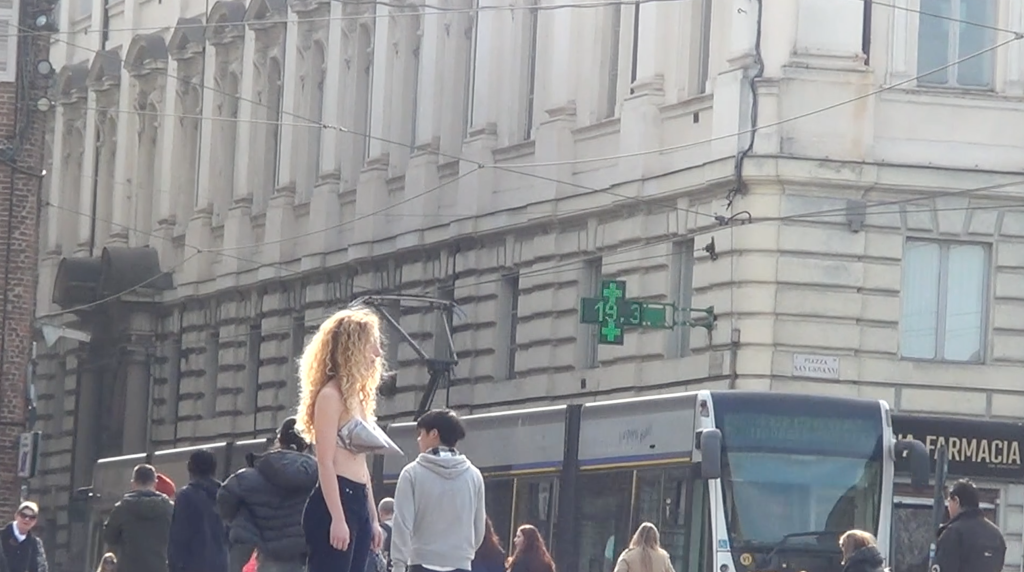
A gaze can brush against something or come to rest; it can insist or withdraw, carry tenderness or exert force. A gaze moves through space, but it also brings space into being – it addresses, and in doing so, positions, drawing bodies closer, or holding them apart. The look is never neutral. It both reflects and produces relations of power; it is shaped by them and, at the same time, acts as one of their instruments. Cultural norms sediment within it, quietly structuring how we encounter others – and how we come to encounter ourselves.
In her performance Âcre, Rachele Zennaro traces these dynamics, reflecting on the conditions that give rise to the gaze and the forms of relation it enables. Of importance is the site where the performance takes place: a town-square, right in front of Turin’s cathedral. The square produces its own rules of visibility, while also pointing to the historically gendered division between public and private, and to the institutional powers that has long governed how the female body is seen.
The text follows the same movement as the performance: it does not seek to declare or oppose, but to attend. What emerges is less a statement than a careful tracing – of gazes, of their trajectories, and of the relations they set into motion. In doing so, it opens a space in which being in relation might be thought, and felt, otherwise.
Âcre emerged from a deeply personal desire to question how the gaze of others – and especially the male gaze – has shaped my own perception of my body and the way I learned to inhabit public space. Growing up, I became aware of how the female body is constantly negotiated between exposure and control, desirability and decorum. This performance takes shape precisely within that tension: an attempt to make visible a mechanism that usually operates invisibly and almost automatically.
The work unfolds as a performative action creating a short circuit between body, public space, and cultural iconography. The artist reinterprets the iconic cone bra made famous by Jean Paul Gaultier in the 1990s – itself derived from 1940s lingerie – removing it from the realm of fashion and relocating it into a symbolically charged urban context: the square in front of Turin’s Cathedral.
Worn on a bare torso, the bra loses its original function and assumes an ambiguous, almost paradoxical role. On one hand, it operates as a visual attractor, intercepting the gaze of passersby; on the other, it exposes the very logic that makes such mediation necessary. The artist deliberately positions herself in a “strategic” way, fully aware that the female body, especially in public space, is still often perceived as inherently provocative.
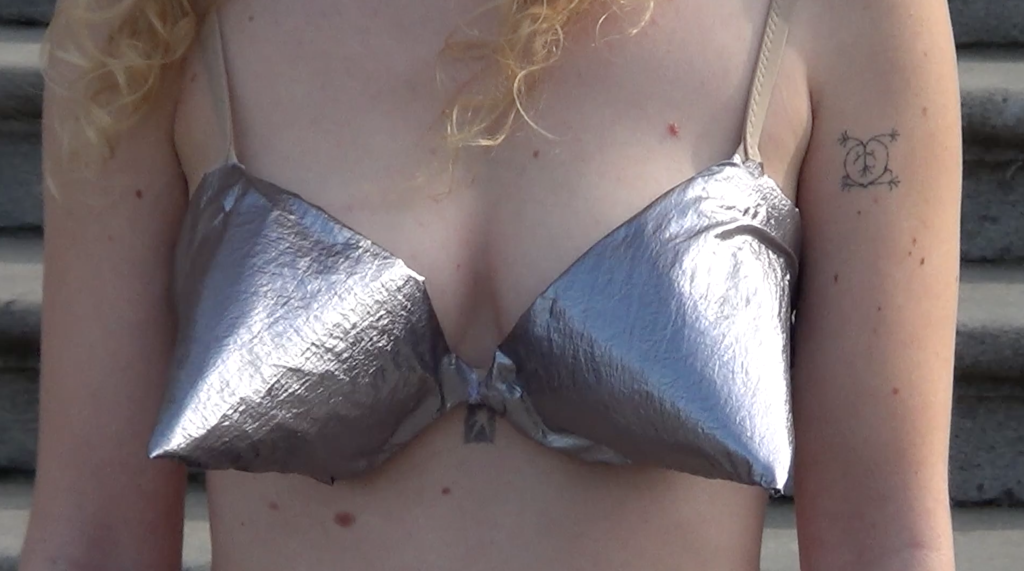
During the performance, I experienced the gaze of others as something intensely physical – not simply observation, but a tangible presence acting upon the body. Some people avoided eye contact, others slowed down, while some stopped to engage in conversation. It was precisely within these dialogues that the work found its most meaningful dimension. Conversations often began with an immediate reaction to the image of the body and gradually shifted toward broader reflections on censorship, learned ways of looking, vulnerability, religion, and sexualization. In many encounters, a difficult-to-name discomfort emerged almost automatically, revealing how deeply internalized certain visual codes still are.
Through this semantic slippage, the work attempts to destabilize the censorship surrounding the female nipple, which is still widely classified as sexual and therefore inappropriate, both in digital and institutional spaces. The performance highlights a normalized paradox: the female nipple is tolerated only when neutralized, filtered, rendered acceptable to a cis-heteronormative male gaze, or confined to the erotic sphere. In this sense, the bra is not merely an iconographic reference, but a symbol mediating between visibility and decorum, between the real body and the acceptable body.
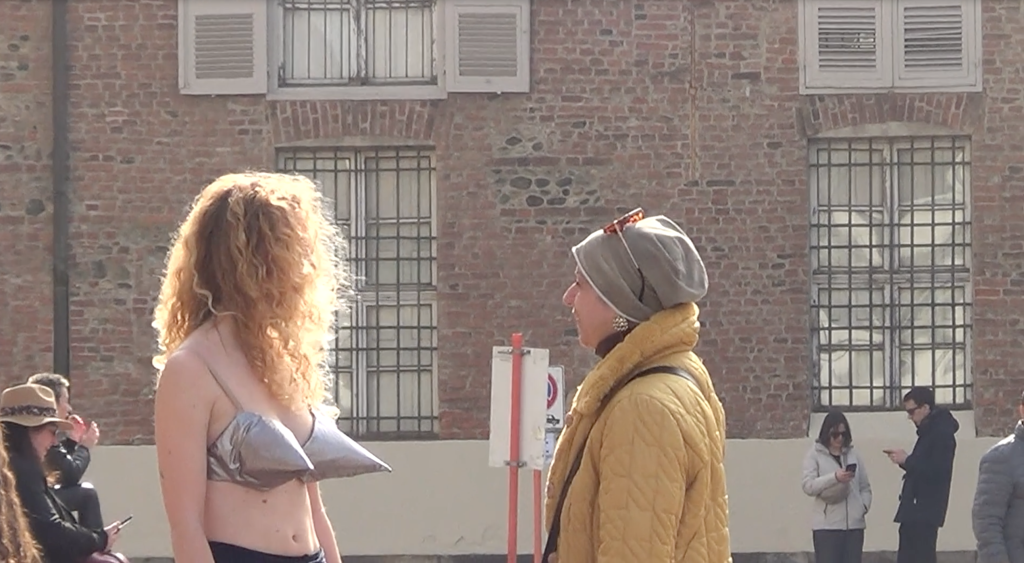
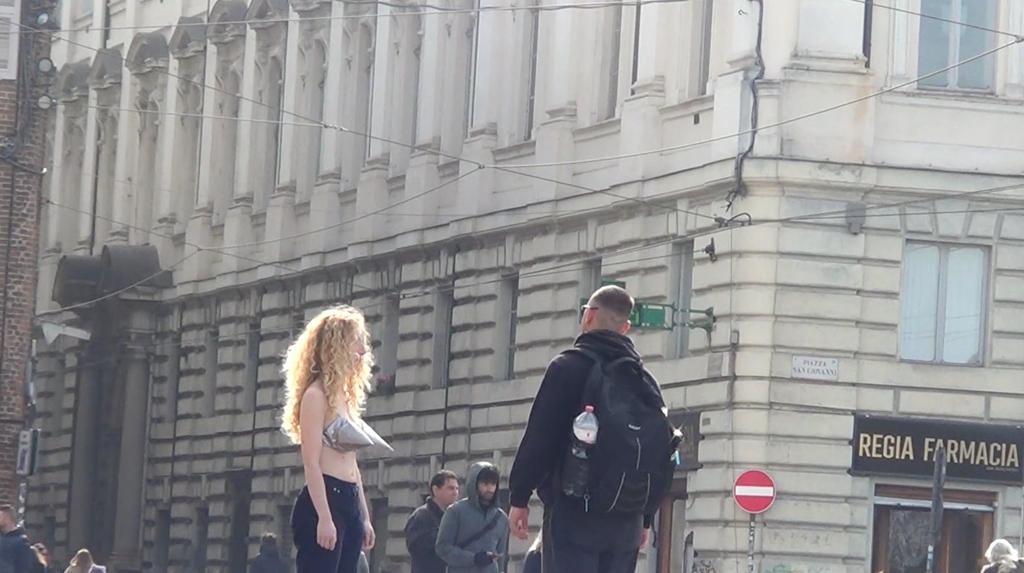
The chosen setting – in front of the Cathedral – inevitably amplifies the tension of the action. Positioned before a building historically embodying moral and symbolic authority over the body, sexuality, and representation, the performance acquires a latent political charge. Yet Acre does not resolve into spectacle or loud protest. Its nature is instead that of a vulnerable gesture entrusted to the encounter with others, accepting the possibility of rejection, misunderstanding, or indifference. The body is not displayed to be contemplated, but to expose the network of gazes that continually shape it. The dialogue generated through the action is not a secondary outcome, but the very material of the work itself.