
709.Reckoning
In conversation with Ella Turner-Bridger on post-human intimacy
and libidinal entanglements with machines
Ella Turner-Bridger and Imke F. Gerhardt | May 2026
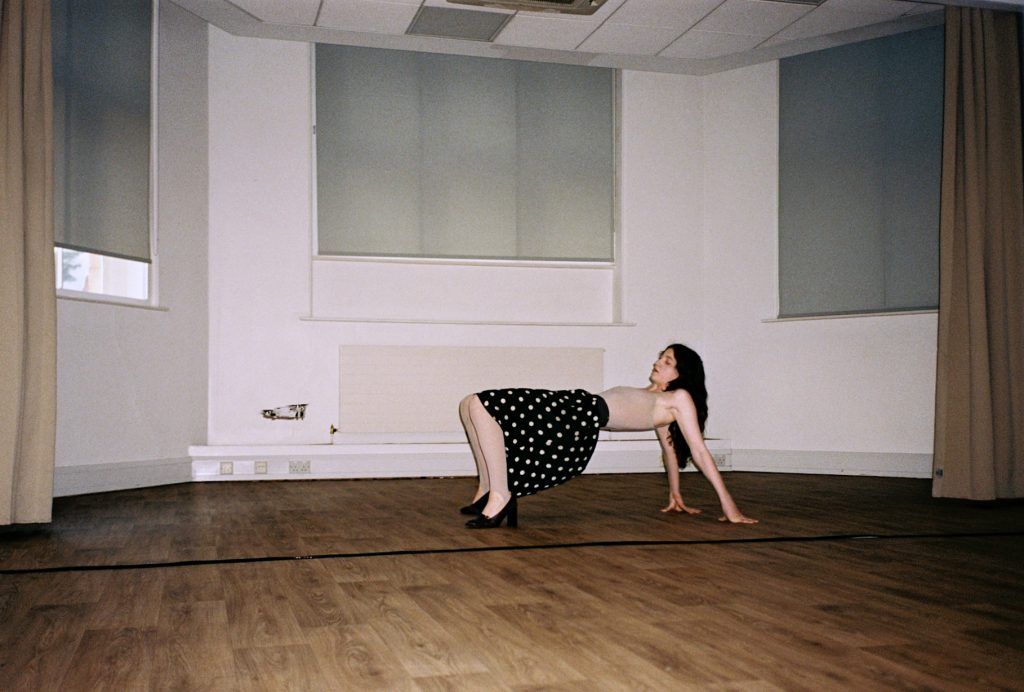
In 709.Reckoning, artist and filmmaker Ella Turner-Bridger performs an intimate encounter with a drone. Circling the performer, the machine acts simultaneously as witness and participant, its camera transforming the act of looking into a charged relation between human and technology.
Presented as part of Chapter 2 – Vision and Flesh, which examines how patriarchal systems are organised and reproduced through relations of the gaze, this conversation with Moving Discourse reflects on the politics and desires embedded in acts of looking. What distinguishes being seen from being watched? What determines the ethics of a (non)human gaze? And how are dominance and control inscribed in relations of vision? In an age of hypersurveillance, drone warfare, and artificial intelligence, Turner-Bridger’s work turns from the infrastructures of technological vision toward its intimate implications: how desire might attach itself to machines, what forms of post-human intimacy emerge, and can an object – or a form of smart technology – be seduced by our gaze?
Imke: I would like to approach this conversation through the notion of projection, using it as a way to think through both the structure of the performance and your relationship with the drone. I am interested in projection in two senses. First, I am referring to the video projection you use in the performance, through which the audience shares the drone’s point of view. Second, I am thinking of projection as a psychoanalytic process – what we, as human beings, project onto the drone Itself.
Before moving further into these thoughts, could you describe the setup and unfolding of the performance?
Ella : It was sparse. The first half of the performance used only natural light until the sun set. A projection of the drone’s POV live feed played in a corner between two pillars. Eventually, it entered the room, scanning the audience as broken words and fragments of syllables audiated. The courtship ritual began. Red light replaced sunlight. We danced to “I Put a Spell on You”. Body grinded against machine. It ended when I knocked the drone from the air with my shoe.
Imke: I’m interested in your intention in using the screen because it fundamentally transforms your relationship with the drone. The screen reorganises the economy of the gaze and directs how the audience reads the performance. Without it, we might read the performance primarily through proximity and distance – through the space between you and the drone – in order to draw conclusions about the relationship between human and machine. With the screen, however, we are placed inside the drone’s first-person perspective. This shift produces an ambivalence: on the one hand, the drone seems anthropomorphised, as if it were endowed with human eyes; on the other, the projected image – shot in black- and-white, with an eerie night-vision quality – renders the drone distinctly machinic, cold, and distant. Is the video, and its specific aesthetic, meant to humanise the drone or to estrange it? And what are the consequences of seeing from the drone’s “I”-perspective, while never from yours? What kind of dynamic emerges from this asymmetry of viewpoints?
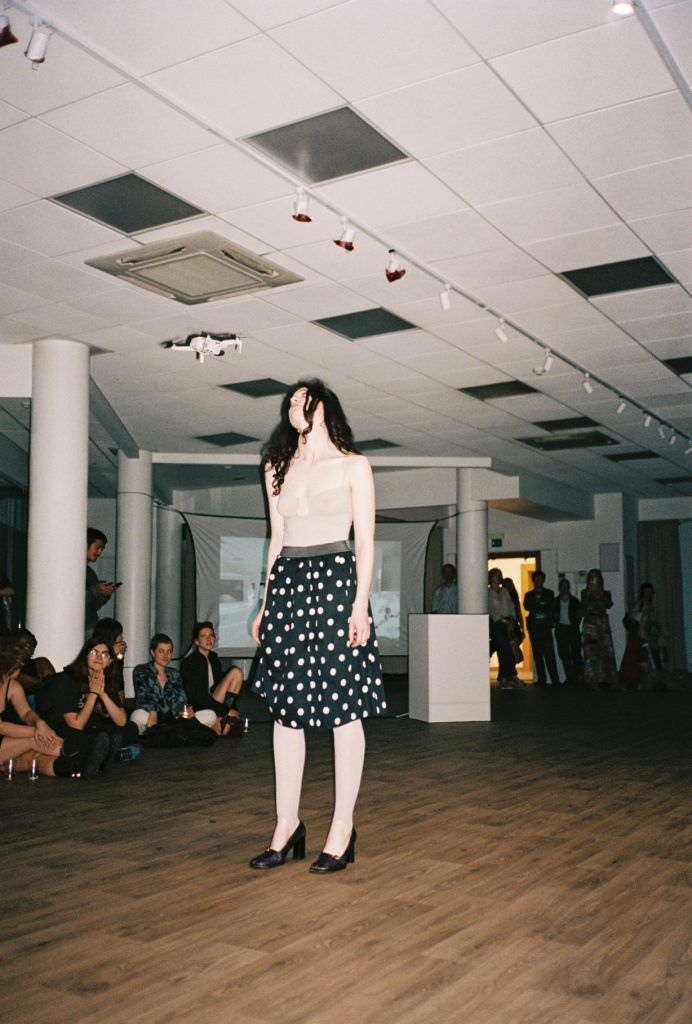
Ella : Using POV gave the drone agency; its own language and perspective. I wanted to scramble the focus between the three subjects at play: myself, the drone and the drone operator. I didn’t want the drone operator to be visible. By introducing the screen, the audience is implicated in the act of looking. I see the camera as a silent witness. I often use rented cameras. I’m always fearful that the next user will know what I’ve done with it, even when I erase the memory card. The camera has no consent when I film something explicit. I’m abusing it, forcing it to look.
Imke: The visual closeness created by the camera might suggest intimacy, yet it simultaneously underscores distance: the absence of touch, the voyeuristic dimension of looking, and a sense of control over another body. Seeing is central to recognition and relationality, but how does being seen differ from being watched? What distinguishes a gaze that acknowledges from one that observes, categorises, or monitors? Could we speak of a warm and a cold gaze?
This line of thought recalls security discourses in which surveillance is framed as care, but it also points to forms of intimacy in digital times, where closeness is predominantly mediated visually. If closeness can be measured through relations of looking, what does it mean to be seen by a calculating eye rather than a recognising one?
Ella : I wanted to remove humanness and identity from the image. I used an inverted filter to toy with expectations of sight. Cameras are designed to mimic human vision. The piece is titled 709.Reckoning. Rec.709 is a common colour space often applied to raw footage, for example on an iphone, that brings the footage closer to how we see colour as humans. I’m interested in how cinematic language can manipulate human perception: a skull violently cracking on a pavement becomes more visceral when it’s foleyed by the sound of a watermelon smashed against the floor. Or how black and white video is perceived as more intelligent. I find that trope so funny, colour being unintellectual. The camera lies. It can metamorphose fiction into reality. We often mistake the camera as a document of truth, but what the camera does best is condense human experience.
Imke: Although you removed humanness and identity from the image, I nevertheless perceive the encounter in times as intimate – perhaps because you are not looking away and binding yourself to the drone through your gaze. In dance improvisation, there is a common task of maintaining uninterrupted eye contact while moving together through space – looking only at the other person, not at the ground or the direction one is heading in. There is a sense of trust embedded in this looking. In a way, this becomes a gesture of mutual commitment: one becomes momentarily oblivious to space, losing oneself in the other.
At times, it appears as if you are searching for something in the opacity of the drone. What are you looking for in the eye of the camera?
Ella: I found solace within the eyes of the drone. It led me through the performance. It was tricky to control the drone, due to its enclosed nature and obstacles like air vents. Often it would enter into a “ghost mode” and move around the space independently. The choreography had to be loose. The drone had to lead. I wanted the drone to dominate me during the first half. As a woman, I sometimes find myself smiling at scary men in the street, in order to make myself seem sweet and inoffensive to them. I’m interested in the balance between flirtation and threat, and of the vulnerability that comes with trust. For the second half, I regain the illusion of dominance, yet I won’t look it in the eye. It’s an experiment in dominance and control.
Imke: Dominance and control are closely linked to relations of looking. In this regard, the relation between human and drone is often defined by an asymmetry. The drone remains distant and largely invisible to us, beyond our ability to look back or meet its gaze, while it sees everything. Maybe this is why I perceive your performance as unsettling and, at the same time, intimate. The drone is unusually close; we can observe it just as it observes us. Hovering at eye level, it allows for a reciprocal visibility that is rarely possible. This shared eye level is particularly striking because it produces intimacy while simultaneously evoking constant surveillance and a sense of exposure. Precisely because this situation is unusual, the performance makes me think of asymmetries of visibility and, consequently, of power – most clearly in the context of drone warfare, with its regimes of remote vision, remote watching, targeting, and killing. To what extent was it your intention to evoke or engage with these current ethical debates? And in what ways does this encounter also reflect broader forms of relating to the “Other” in the digital age?
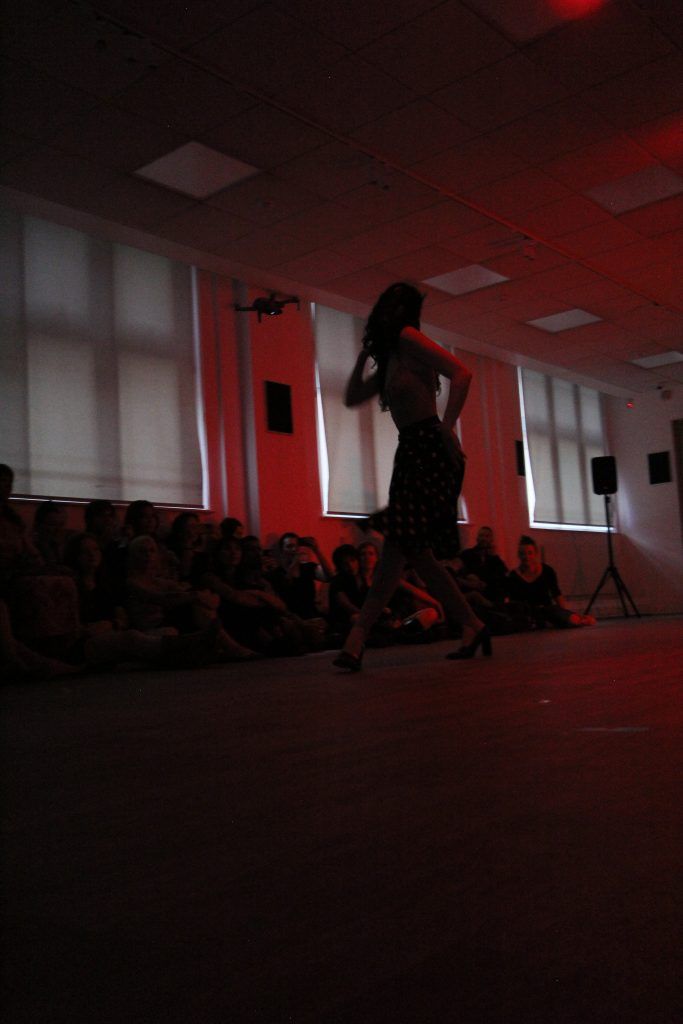
Ella: Of course the drone is a politically loaded device. It relates to power, surveillance and warfare, but I’m interested on a personal level rather than macro. I’m interested in self portraiture. I spend a lot of time alone, so it made sense to use myself as material, and the drone for companionship during my solitude. It became an extension of my hyper independence. A machine is inherently masculine. In filmmaking, the terms are masculine and associated with warfare, for example “shoot”, “load”, “cut”, “the barrel of the lens” etc. Yet the act of looking at yourself being looked at is feminine, I wanted to play with that.
Imke: Intimacy usually presupposes a shared vulnerability. Yet precisely this seems impossible in the relationship with a drone. The drone acts remotely, it is detached from presence. It renders others vulnerable without being vulnerable itself. This asymmetry makes the drone uncanny – difficult to grasp, resistant to reciprocity. To me, uncanniness is central to the performance. The ominous music that accompanies the drone’s appearance already announces it: something unsettling is approaching. The uncanny here is not easily locatable; it seems to hover in the in-between. This raises a question: does the uncanny emerge from what we see – from the images projected onto the screen, from the logic of surveillance itself? Or is it produced precisely by what remains invisible, yet is nonetheless projected onto the drone – our fears, assumptions, and imagined intentions?
Ella: The uncanniness comes from the anthropomorphism of the drone. The drone holds a lot of anxiety, its sharp blades, the threatening noise, its unpredictability in movement. For me the drone is symbolic of human failure. It’s a flawed machine. To interact with it as if it’s human is a flawed act. That’s where the uncanny originates. I’m trying to find love and seduce an object that doesn’t care.
Imke: The entire performance has a climactic structure, yet this tension unfolds almost entirely through your behaviour. The drone itself does not change – its actions remain essentially constant – to the transformation occurs primarily on your side: in perception, imagination, and response. You are acting to something that, on a purely technical level, behaves the same throughout. In this sense, we seem to project our anxieties onto it. Anxiety is not tied to a specific danger, but remains diffuse, atmospheric, and anticipatory. The drone does not attack; it waits, hovers, observes.
Given that the drone’s behaviour remains unchanged, I wonder: what are you projecting onto it that creates this climactic narrative?
Ella: Even though the dynamics between me and the drone change, emotionally I am fixed. I am watched and mediated. I am fake and made up for the drone. I begin as I mean to end and the robot doesn’t care. The death of the drone is comedic. I’ve been controlled by a device that I can destroy with my shoe.
Imke: To end, I would like to move from projections of fear to projections of desire. Desire can be attached to non-human objects. Today, AI in particular seems to be becoming an object of projection, a recipient of libidinal investment. I wonder: is your performance a comment on eroticisim under conditions of technological mediation – for example, the AI chatbot, which simulates the “Other” and reflects our desires back to us?
Ella: Twilight (2008). Dir. Catherine Hardwicke”
Bella: So what… you… you read minds?
Edward: I can read every mind in this room apart from yours. There’s… Money. Sex. Money. Sex. Cat.